Investors · EB-5 guide
The EB-5 regional center model
A plain-language guide to what a regional center is, the filings it makes with USCIS and how a PacinfraX project would select one. No offering is being made on this website.

Basics
What a regional center is
A regional center is an economic unit, public or private, that USCIS has designated to take part in the Regional Center Program. It sponsors EB-5 projects inside a defined geographic area and files the project applications that allow investors in those projects to petition through the program.
Regional centers matter most for job counting. A regional center project can count indirect and induced jobs, estimated with an economic model, as well as direct jobs. A standalone EB-5 investment outside the program counts only direct jobs created by the new commercial enterprise itself.
The rules discussed here come from the EB-5 Reform and Integrity Act of 2022 and the USCIS pages linked at the end of this guide. They are general information. Each investor confirms how they apply with their own counsel.
Filings
Designation, project applications and annual statements
The 2022 Act set out a family of forms for the program. Four of them shape how a regional center works with a project.
Four forms and what each one does
Form I-956: Designation
The application a regional center files to be designated by USCIS. Designation sets out the center’s approved geographic area and its organization.
Form I-956F: Project application
Filed by the regional center, not by the developer, for each project it sponsors. It carries the business plan, the economic analysis and the offering documents, and it is filed before investors in that project file Form I-526E.
Form I-956G: Annual statement
The regional center’s annual statement to USCIS on each project it sponsors, including how EB-5 capital has been used and what the center has done to monitor it.
Form I-956K: Promoter registration
Registration for people who promote a regional center project, including migration agents, filed with a written agreement with the issuer.
Why the order of filings matters
Under the 2022 Act, a regional center files Form I-956F for a project before investors in that project file Form I-526E, and USCIS decides the project application before it decides the related investor petitions. For an investor, this means the project’s documents and economic analysis are already in front of USCIS when their own petition arrives. For a developer, it means no investor files for a project until the regional center has filed for it.
Geography
The approved geographic area
Every regional center has an approved geographic area, set through its designation. A project must sit inside that area for the center to sponsor it. A center can ask USCIS to change its area, as counsel advises, but a developer cannot assume that a given center will cover a given site.
For a company that builds campuses in more than one state, this is the first practical filter. A center that serves one part of Texas might have no reach in Minnesota, and the reverse. It is one of the reasons PacinfraX selects a regional center per project rather than for the whole platform.
Rural and high-unemployment areas
Whether a site sits in a rural area or a high-unemployment area is a separate question from the geographic area. It is determined for each project in the regional center’s filing, with an economist and counsel, and never assumed on a website. Read targeted employment areas and rural projects, explained.
Sponsorship
Sponsoring a third-party new commercial enterprise
Many regional centers do not develop projects themselves. Instead, they sponsor a new commercial enterprise formed by a developer. Under the 2022 Act, that NCE is affiliated with the regional center that sponsors it, and the center takes on filing and monitoring duties for the project.
In this third-party model the roles stay distinct. The developer, through its job-creating entity, builds and operates the project. The NCE holds investor capital and provides it to the JCE. The regional center files Form I-956F, files its annual statements and monitors the project’s compliance with the program. Each party’s duties are set out in written agreements reviewed by counsel.
Indirect and induced jobs
Indirect jobs arise at suppliers and contractors because of the project’s spending. Induced jobs arise when direct and indirect workers spend their wages in the local economy. These jobs can count toward an investor’s job creation requirement only in a regional center project, and only when estimated with a reasonable economic methodology. The Act also requires that a share of the jobs be direct jobs; how that applies to a given project is a question for the project’s economist and counsel. Read job creation for data center campuses.
Integrity
Integrity measures under the 2022 Act
Photo: advisor and client reviewing documents

The 2022 Act added integrity measures for regional center projects. EB-5 capital is held in a separate account at a US bank for one project, and a fund administrator oversees transactions into and out of that account; alternatively, an annual independent financial audit is provided to USCIS and investors, as counsel advises for each structure. People who promote a regional center project, including migration agents, register with USCIS on Form I-956K and work under a written agreement with the issuer; under the DHS proposed rule, fees paid to them would be set out in writing for investors. Regional centers also file annual statements on Form I-956G for each project they sponsor.
Authorization
Program authorization
The Regional Center Program is authorized through September 30, 2027. Reauthorization is a matter for Congress and is not assured. The standalone EB-5 category, which counts only direct jobs, is a permanent part of the law. Investors considering a regional center project discuss with their own counsel what reauthorization, or its absence, would mean for a petition filed at a given time. PacinfraX does not predict what Congress will do.
PacinfraX
How a PacinfraX project would select a regional center
PacinfraX organizes EB-5 participation project by project. Each project would have its own new commercial enterprise, paired with its own job-creating entity, and each project would select its regional center with counsel. The selection looks at five things:
Photo: project offices on a campus at dusk
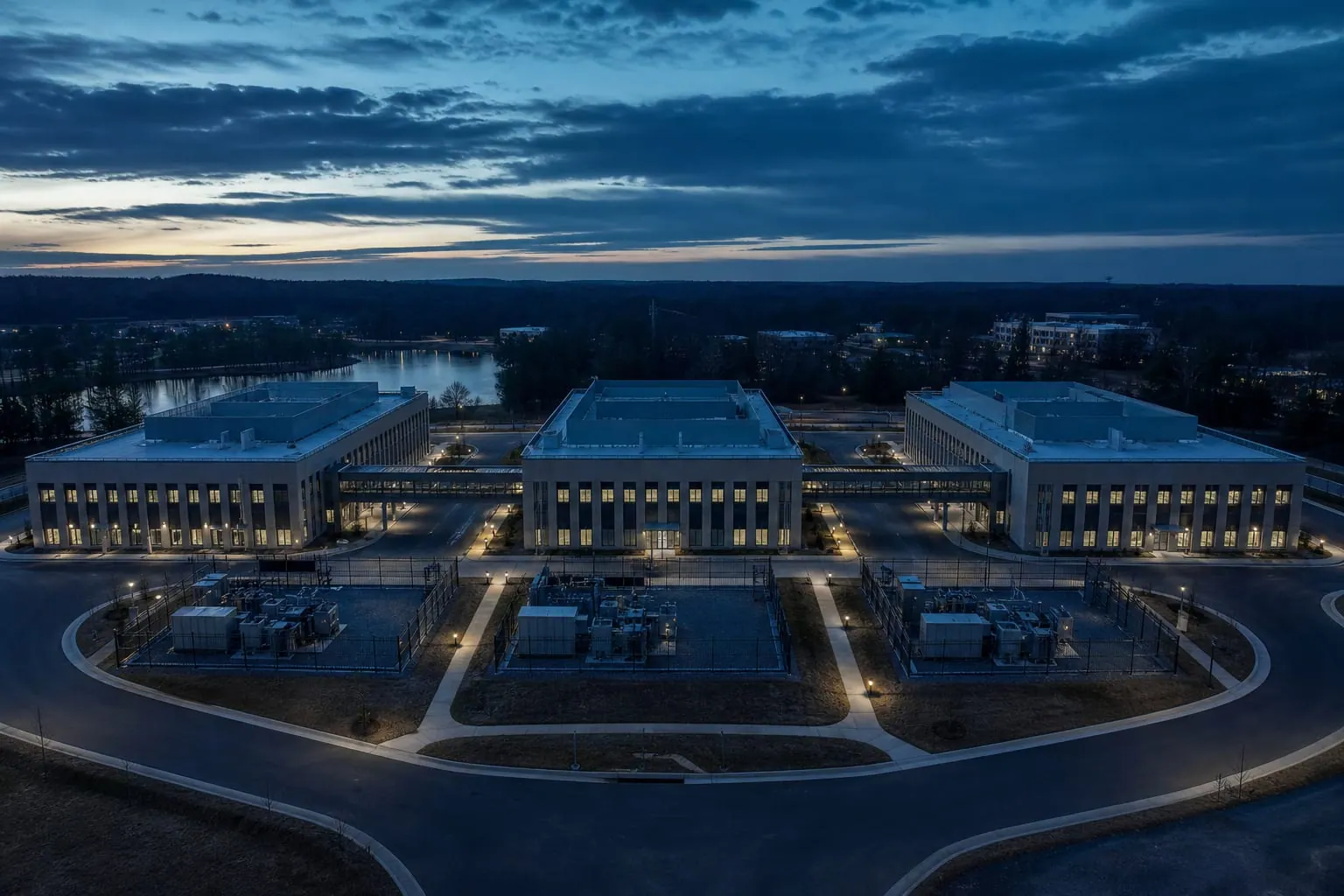
Five things the selection looks at
- Whether the center’s approved geographic area covers the site.
- The center’s experience in that state.
- Its experience with large construction programs and long-lived infrastructure assets.
- Its compliance record with designation, annual statements and project filings.
- Its arrangements for fund administration, audits and escrow.
Because each project makes its own choice, two PacinfraX campuses can work with two different regional centers, or with the same one where it fits both. The structure is explained in per-project structure: one NCE, one JCE, one regional center.