The problem power-first solves
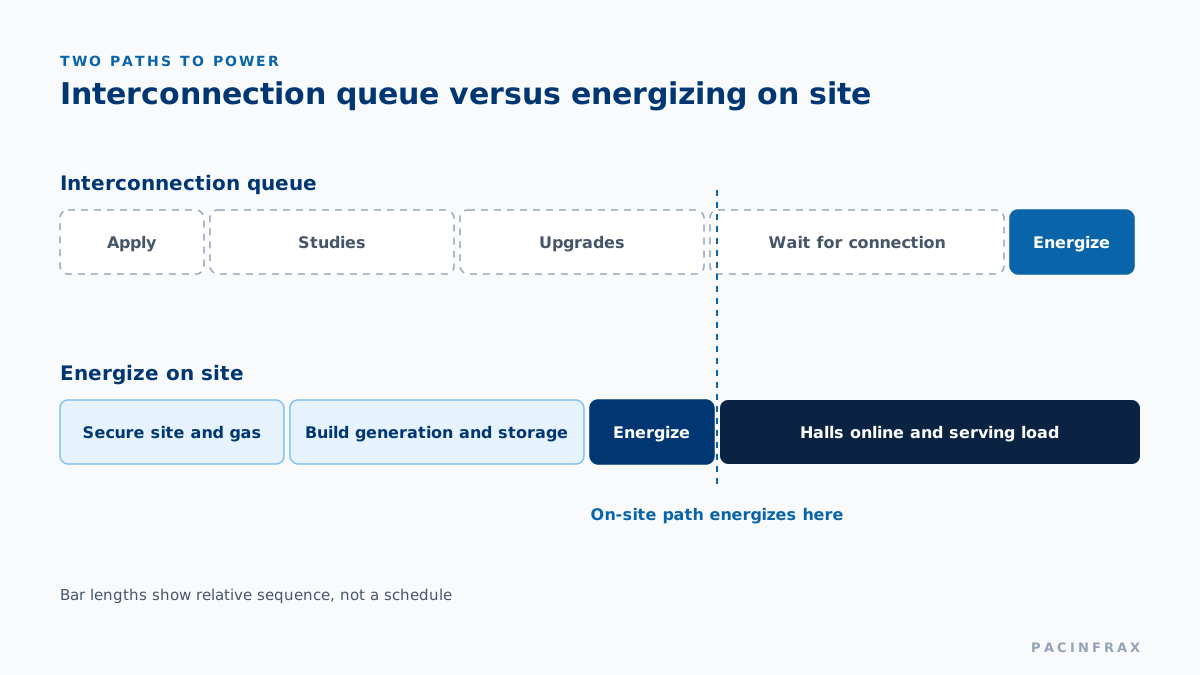
An AI hall can be built faster than a utility can connect it. Grid operators study every large new load in sequence, and each study depends on transmission upgrades that take time. Public grid operators publish data on how much load they serve and forecast; ERCOT, for example, shares forecasts and historical power load for its control area on its Load page. For a buyer, the practical effect is simple: the building is ready, the racks are ready, and the power is not.
Power-first development changes the order of work. It treats energy as the first deliverable and the building as the second.
The power-first model in four parts
Every power-first campus combines four elements. Each one covers a weakness in the others.
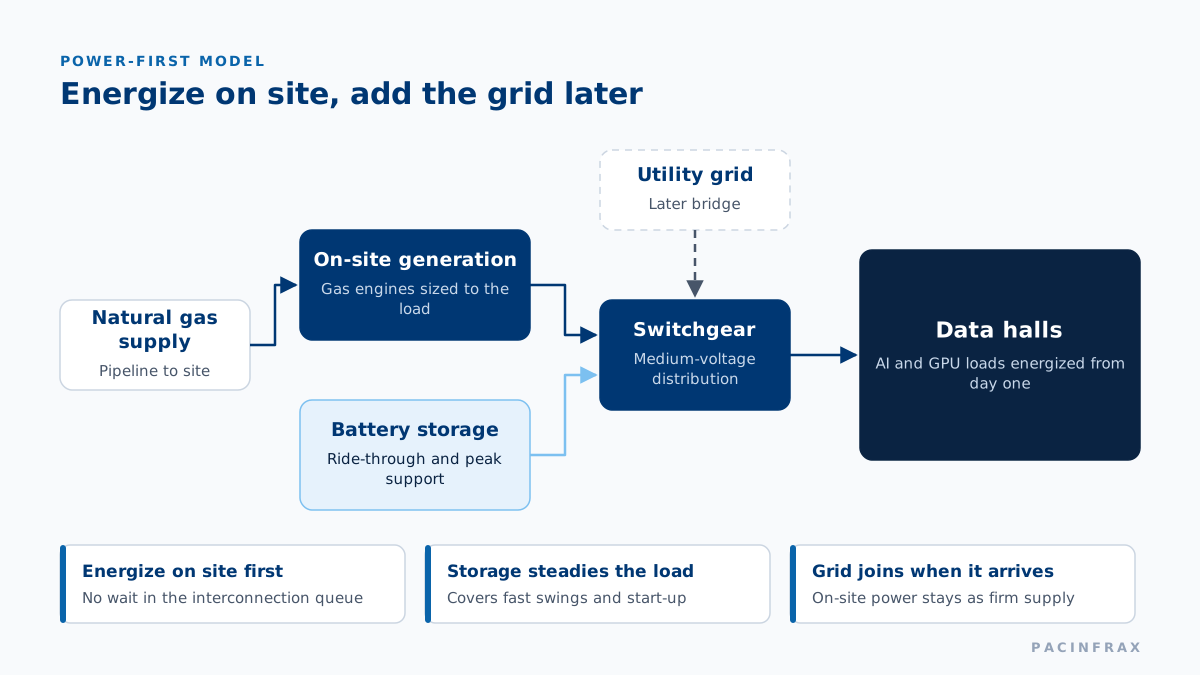
| Element | Role | Detail page |
|---|---|---|
| On-site natural gas generation | Firm base supply for the campus | On-site generation |
| Battery storage | Ride-through, peak support and smoothing of load swings | Battery storage |
| Switchgear and distribution | Independent paths to each hall | Power infrastructure |
| Bridge to grid | Utility connection designed from day one and joined later | Bridge to grid |
Why natural gas, and where it comes from
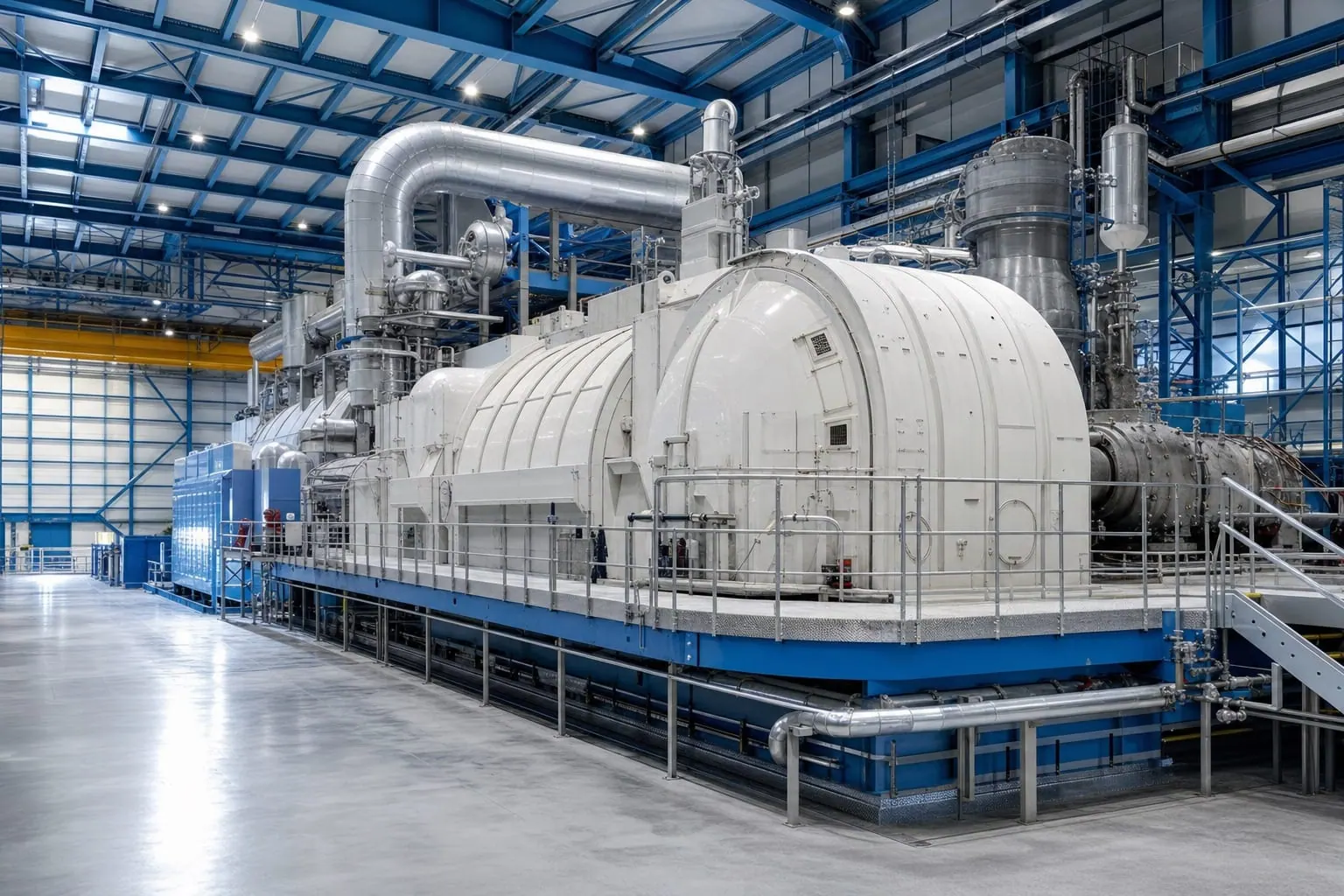
Natural gas generating units can be installed in modules, start quickly and run on a fuel delivered by pipeline. The U.S. Energy Information Administration notes that most of the natural gas consumed in the United States is produced in the United States, as described in its Natural gas explained overview. A site near existing pipelines can secure fuel without long new infrastructure.
Fuel contracts, pressure and metering are part of the design. Engineers specify a gas valve station and metering skid at the site boundary, and the plant is built with spare generating units so one outage never stops the campus.
Bridge to grid: a timeline, not a switch
Power-first does not mean off-grid forever. The grid interconnection is filed and designed at the start, runs in parallel with construction and joins when the utility completes its work. Until then, on-site power carries the load.
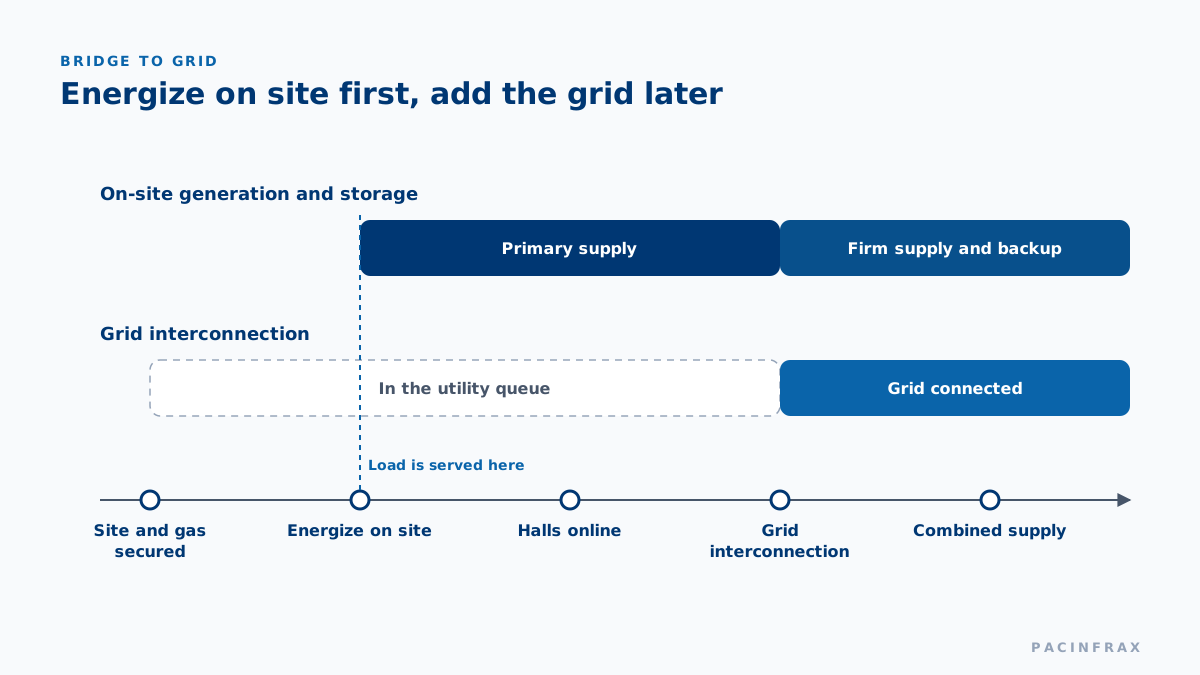
Once the grid arrives, the campus gains a second source. On-site units can then serve as backup, peak support or a continuing part of the supply. The choice is documented in the power plan.
Power-first versus grid-first
| Question | Grid-first | Power-first |
|---|---|---|
| What sets the energization date? | The utility study and upgrade schedule | Construction of generation, storage and hall |
| Who builds the power? | The utility, outside your control | The developer, inside one plan |
| Main risks | Queue position, upgrade delays | Fuel supply, permits, operations |
| Fallback if a date slips | Wait | Add units or storage on site |
| Best fit | Sites with a connection already agreed | Large loads that cannot wait for a queue |
Neither route wins every time. A site with an agreed connection date is a strong grid-first site. The point is to know which risk you are buying.
The development sequence, step by step
A power-first project follows a fixed order. Each step produces a document you can ask the developer to show you.
- Site screening: fuel, transmission, land and fibre are checked against a criteria list.
- Power concept: the single-line diagram sets generation, storage, switchgear and the grid bridge for the full buildout.
- Permits and agreements: fuel supply, air permits, land rights and the interconnection request move forward together.
- Phased design: power blocks and halls are drawn as matching phases.
- Construction: EPC partners build power and halls in parallel to one design.
- Commissioning and energization: the plant is tested under load before any tenant hardware is switched on.
- Operations: the developer-operator runs the plant and hall, and adds the grid when it arrives.
What a power-first site needs
Developers choose sites on a short list of criteria. The first four decide whether the model works at all.
- Fuel access: a pipeline with capacity and a route to the site.
- Transmission access: a nearby line or substation for the later grid bridge.
- Land and zoning: room for power island, halls and expansion blocks.
- Permits: a path for air, water and local approvals.
- Water and cooling: a heat rejection strategy suited to the climate.
- Fibre: diverse routes to carriers and cloud on-ramps.
The full list is in our site selection checklist. For Texas context, read Texas data center power.
What changes when the developer owns the power plant
A conventional data center buys electricity. A power-first campus produces it, and that adds disciplines a hall-only operator does not need. A credible developer shows how each one is covered.
- Permitting: generating units need air permits and local approvals. Early filing protects the schedule.
- Operations: the plant needs trained operators, a maintenance program and spare parts on site.
- Controls: one control system should coordinate engines, batteries and switchgear, with operators watching a single set of screens.
- Fuel management: metering, pressure monitoring and a contract that matches the load profile.
- Interfaces: a single point of accountability between power plant and hall removes finger-pointing during faults.
This is why the model works best with a developer-operator. When the team that designs the plant also runs it, lessons from operations flow back into design, and the customer deals with one party.
Four questions that test any developer
- What is the power source? Name the fuel, the pipeline and the equipment.
- What is the energization date? Ask for the milestones behind it.
- What is the fallback? A credible plan covers delayed equipment, fuel interruption and permit changes.
- Who is accountable? One named team should own the power plant and the hall.
Developers that answer in specifics have usually done the work. Vague answers about timing usually mean the power path is not secured.
How PacinfraX does it
PacinfraX develops and operates power-first AI campuses. In South ERCOT, Texas, we are developing an AI campus with on-site gas generation and storage. In Minnesota we have a powered industrial site. In Vietnam, PacinfraX Vietnam has signed four site agreements with companies of BIN Corporation for a planned 1,200 MW, announced on 30 October 2026.
Start with why PacinfraX, then see power infrastructure, Texas and Vietnam. If you need energized capacity, Request capacity.
Frequently asked questions
What does power-first mean in plain terms?
It means the power plan is the first design decision, not the last. The developer secures generation, storage and the grid path for a site, then builds the data hall around that supply, so energization follows construction instead of waiting on the utility.
Is on-site generation a replacement for the grid?
No. On-site generation energizes the campus first and gives you firm capacity during the wait. The grid connection is designed from day one and joins as a bridge, so the campus can run on both over its life.
Why does battery storage matter for AI?
GPU training swings from low to full load quickly. Batteries absorb those swings, cover switchovers between sources and let generating units run at steady output. That protects equipment and keeps the load stable for the cluster.
What are the risks of a power-first campus?
Fuel supply, equipment lead times, air permits and operating complexity. The answer is to choose sites with firm gas supply, secure permits early, hold spare units and keep one accountable operator for the power plant and the hall.
How do I compare a power-first site with a grid-first site?
Compare the date energized capacity is available, the evidence behind that date, and the fallback if it slips. Ask for the interconnection agreement status on one side and the fuel contract and permit status on the other.