Why site selection comes first
Every other decision in an AI data center project follows from the parcel: how much capacity it can host, how fast power arrives, which cooling design works and what the permits look like. A weak site cannot be fixed with a strong design. A strong site shortens every later step.
Hyperscalers, AI labs and neoclouds ask the same questions in the same order. Where does the power come from? When can it be energized? How many megawatts can the land hold? Can we expand? The twelve criteria below are organized around those questions, so a landowner or EPC partner can answer them before the first call.
For how a power-first campus is then built on a good site, read power-first data center development.
The twelve criteria
Each criterion has a weight. Critical criteria can stop a project outright. High criteria shape cost and schedule. Medium criteria shape design.
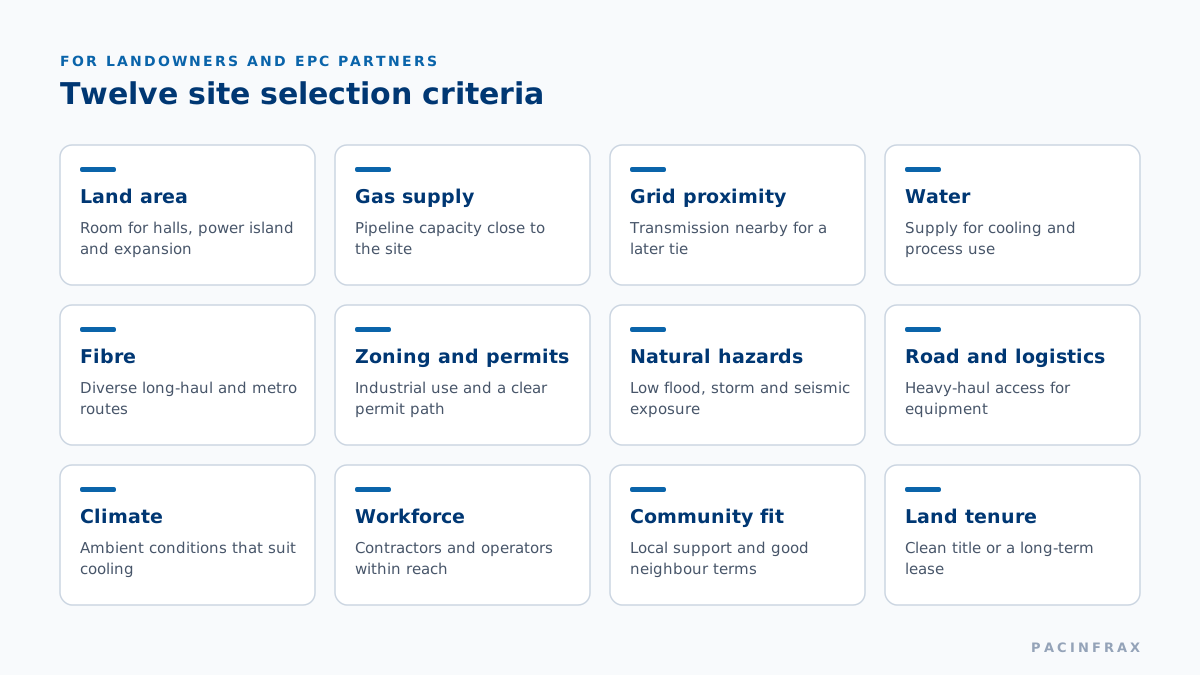
| # | Criterion | Weight | The question to answer |
|---|---|---|---|
| 1 | Power path | Critical | Is there a route to tens of megawatts: on-site generation, a nearby high-voltage substation, or both? |
| 2 | Natural gas supply | High | Is a transmission-grade gas pipeline close enough to tap, with room for a metering station? |
| 3 | Grid interconnection | High | How far is the nearest substation, at what voltage, and who owns the line? |
| 4 | Land area and shape | High | Is there contiguous land for a first hall block, a power island and expansion blocks? |
| 5 | Zoning and entitlement | High | Is the parcel zoned for industrial use, and what approvals are still open? |
| 6 | Water and heat rejection | Medium | Is there a water source or a dry-cooling path, and what are the local limits? |
| 7 | Fibre and latency | High | Do two physically diverse fibre routes pass within reach? |
| 8 | Natural hazards | Medium | What are the flood, seismic and wind exposures for the parcel? |
| 9 | Road and heavy-haul access | Medium | Can transformers, engines and chillers reach the site on public roads? |
| 10 | Title and easements | Critical | Is title clean, and are there easements, liens or mineral-rights splits? |
| 11 | Environmental and permits | High | Which air, stormwater and habitat permits will on-site generation require? |
| 12 | Community and workforce | Medium | Is the local government supportive, and is there a construction labor pool? |
Power: the first three criteria
Power path. Start with the question a hyperscaler asks first: how many megawatts, and when? A site qualifies when at least one credible route exists, either on-site generation or a short line to a high-voltage substation. Two routes are better than one.
Natural gas supply. On-site generation runs on pipeline gas. Look for a transmission-grade pipeline close to the parcel and the right to tap it. Distribution-grade lines rarely carry the volume a campus needs. A gas tap needs space for a metering and valve station, which we cover in power infrastructure.
Grid interconnection. Even a campus that energizes on its own generation benefits from a later utility connection. Note the distance to the nearest substation, the line voltage and the owner. The longer the grid timeline, the more valuable the gas route becomes, a theme we explore in Texas data center power.
Land and approvals: criteria four, five, ten and eleven
Land area and shape. A campus needs contiguous land for hall blocks, a power island, substation, cooling plant and laydown. Irregular parcels waste area. Land that can be assembled from neighboring parcels counts, if the owners are willing.
Zoning and entitlement. Industrial zoning is the best start. If the land needs rezoning, say so and describe the local process.
Title and easements. Confirm who owns the surface and the minerals, and list every easement, lien and lease. Split mineral rights and unknown heirs are frequent title problems on rural land.
Environmental and permits. On-site generation brings air permitting. Stormwater, habitat and cultural-resource reviews apply to most construction. A site with prior environmental reports moves faster.
Connectivity and logistics: criteria six to nine
Water and heat rejection. Liquid-cooled halls reject heat through dry coolers, cooling towers or a mix. Water availability and local limits steer the choice. A site with limited water can still work with a dry-cooling design. See liquid cooling for AI data centers.
Fibre and latency. AI training tolerates distance. Inference and enterprise colocation do not. Two diverse fibre routes near the parcel, or a fibre builder willing to extend to it, protect the site's future customers.
Natural hazards. Flood, seismic and wind exposure shape the structure and the insurance. The FEMA Flood Map Service Center gives a first read on flood zones for any US parcel.
Road and heavy-haul access. Transformers, engines and chillers are heavy and oversized. Check bridges, turning radii and the nearest rail or port.
Community and workforce: criterion twelve
A campus is a multi-year construction project followed by a permanent operation. Local support makes permits smoother and hiring easier. Note the local government's stance on industrial development, the nearby labor pool for electricians, pipefitters and civil crews, and any housing constraints for construction workers.
Community benefit is part of the plan, not an afterthought: jobs during construction, a tax base afterwards and, where it fits, shared infrastructure. Our government team works with host authorities from the first conversation.
A simple scoring method
Score every criterion from 0 to 3.
- 0: a blocker with no known solution.
- 1: a gap that needs significant work or cost.
- 2: workable, with open items.
- 3: in place and documented.
Then apply three rules. No zero on a critical criterion. At least two of the three power criteria at 2 or higher. Title at 2 or higher before any money is spent on studies. A site that passes these rules deserves a first call. A site that fails one rule can still be worth discussing if you know how to close the gap. Write the scores and a one-line reason for each. The reasons are more useful than the numbers.
What to send us
Send a short package. A partial package is fine.
- Location: coordinates or a parcel map, plus the nearest town.
- Land: total acreage, shape, current use and any planned subdivision.
- Title: owner name, ownership structure and any easements or liens you know of.
- Power: nearest substation, line voltage and owner; any prior load study.
- Gas: nearest pipeline, operator and any existing tap or capacity letter.
- Fibre: carriers on or near the parcel.
- Zoning: current designation and any entitlement history.
- Surveys: ALTA, topographic, geotechnical, environmental or flood reports you already hold.
- Terms: whether you want to sell, lease or contribute the land into a joint venture, and your timeline.
Email [email protected] or use the contact form. Partners can read more on the partners page.
How PacinfraX uses this checklist
PacinfraX develops and operates power-first AI data center campuses. We apply these criteria in South ERCOT, Texas, where an AI campus is in development with on-site gas generation and storage, in Minnesota, where we are working on a powered industrial site, and in Vietnam, where four site agreements cover a planned 1,200 MW.
Because we design the power, the hall and the cooling together, we can accept sites that need a power solution built from scratch. We look for partners across land, EPC, power, technology and offtake, and we work with each landowner on a structure that fits.
Site selection questions, answered
How much land does an AI data center campus need?
It depends on the capacity target and the power plant. A campus needs land for one or more hall blocks, a power island with generation and storage, substation space, cooling plant, laydown and a buffer. Send us your parcel and we calculate the fit against a 10–50 MW block layout.
Does the site need a grid connection today?
No. A site with a credible gas supply can energize on on-site generation and storage first, then add a utility connection later through a bridge-to-grid design. Proximity to a substation still raises the value of the parcel.
Who should send a site: landowners or EPC firms?
Both. Landowners send parcels and title information. EPC firms and developers send sites they control or can option, plus construction capability. Partnerships with power, technology and offtake companies are also welcome.
What happens after I send my site?
We reply within two business days. A first call confirms the basics, then our team scores the site against the twelve criteria and tells you where it stands and what is missing.
Do you buy land, lease it or form a joint venture?
The structure depends on the site and on what you want. Landowners can sell, lease or contribute land into a joint venture. We agree the structure after the first review, once we know the power path and the title position.
Do I need all twelve answers before contacting you?
No. Send what you have. Unknowns are normal at the first call, and several of the criteria, such as hazards and permits, are answered by studies we can scope together.
Sources and further reading
- FEMA Flood Map Service Center: look up the flood zone for a US parcel.
- TIA-942 data center standard: the telecommunications infrastructure standard that covers site and facility considerations.
- US Department of Energy: data centers and servers: public guidance on data center energy use and efficiency.