
Why PacinfraX
Power-first AI data center delivery
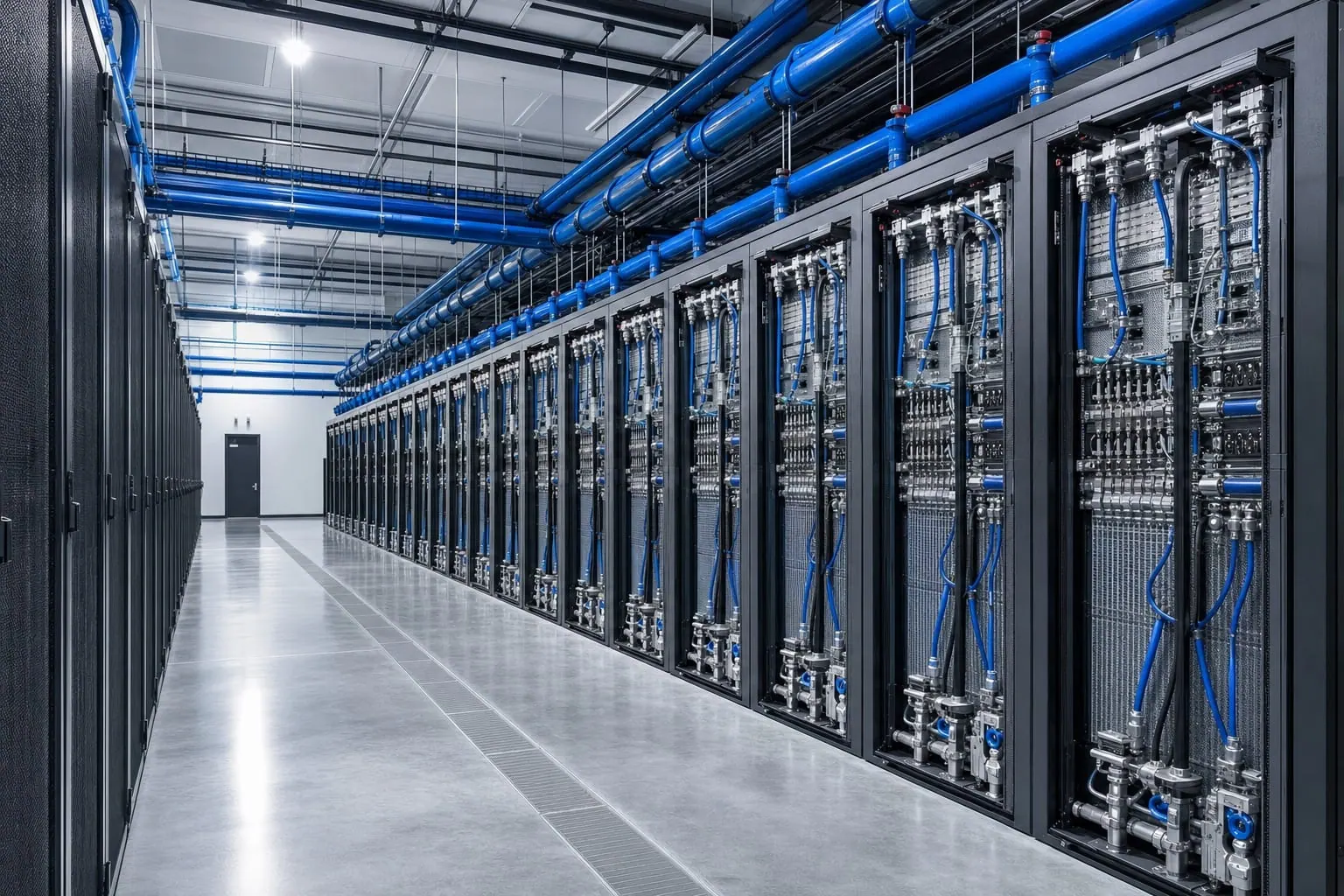
PacinfraX builds the power before the hall. We engineer on-site generation, battery storage and a bridge-to-grid path together with liquid-cooling-ready halls, then deliver them in phased 10–50 MW blocks. You get energized AI capacity on a timeline set by construction, from one developer-operator.
Our model
Power first. AI at scale.
AI demand is outrunning grid connections. A 50 MW customer needs to know three things before signing: where the power comes from, when the hall is energized, and how the next block gets added. Our model answers all three on the first call.
How each campus pairs power with its halls
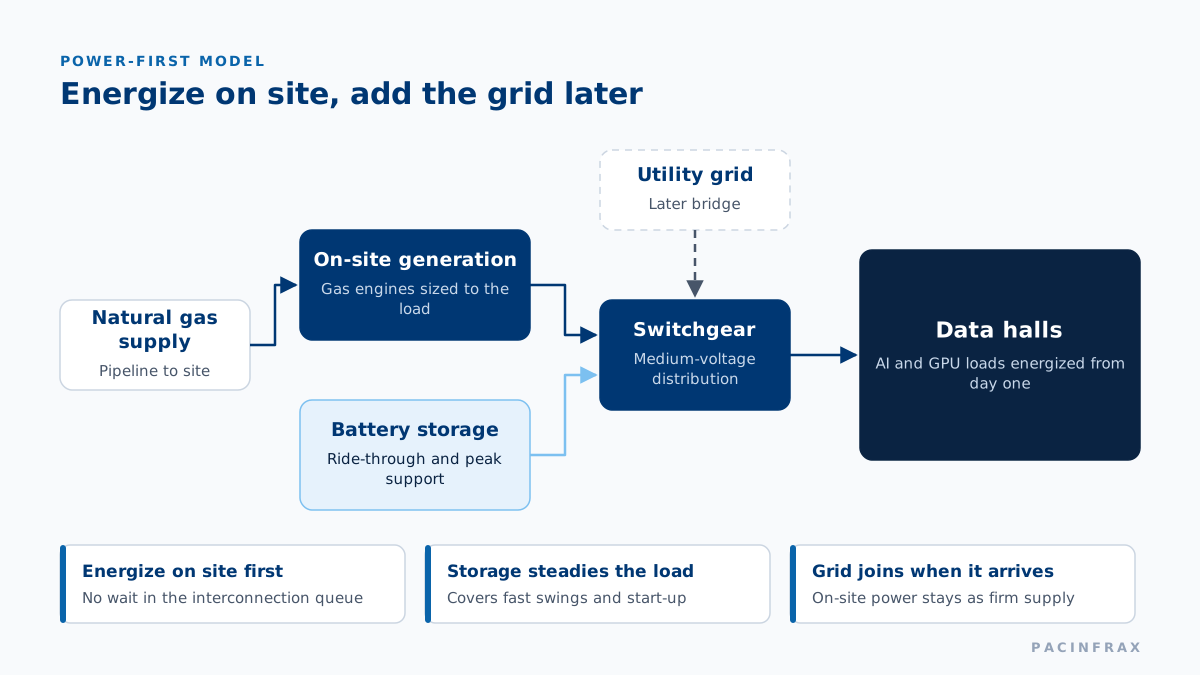
Each campus pairs on-site natural gas generation and battery storage, or an already-powered site, with its halls. Storage smooths the sharp load swings of GPU clusters. Bridge-to-grid design lets the campus join the utility network later without touching the hall.
Read the full method in power-first data center development, or see the stack on our power infrastructure page.
Diagram: the power-first model
Speed
Speed: energize on the construction schedule
Most AI projects stall on one question: when does the power arrive? We answer it before we pour a slab. On-site natural gas generation and battery storage, or an already-powered site, are engineered together with the hall, so the building and its power finish together.
Speed: key points for your deployment
- The power path is locked before design freeze, so the date we commit to is a construction date.
- Power plant and hall rise in parallel. Neither waits on the other.
- Bridge-to-grid design connects the campus to the utility network when it arrives, with no rebuild of the hall.
What it means for your deployment
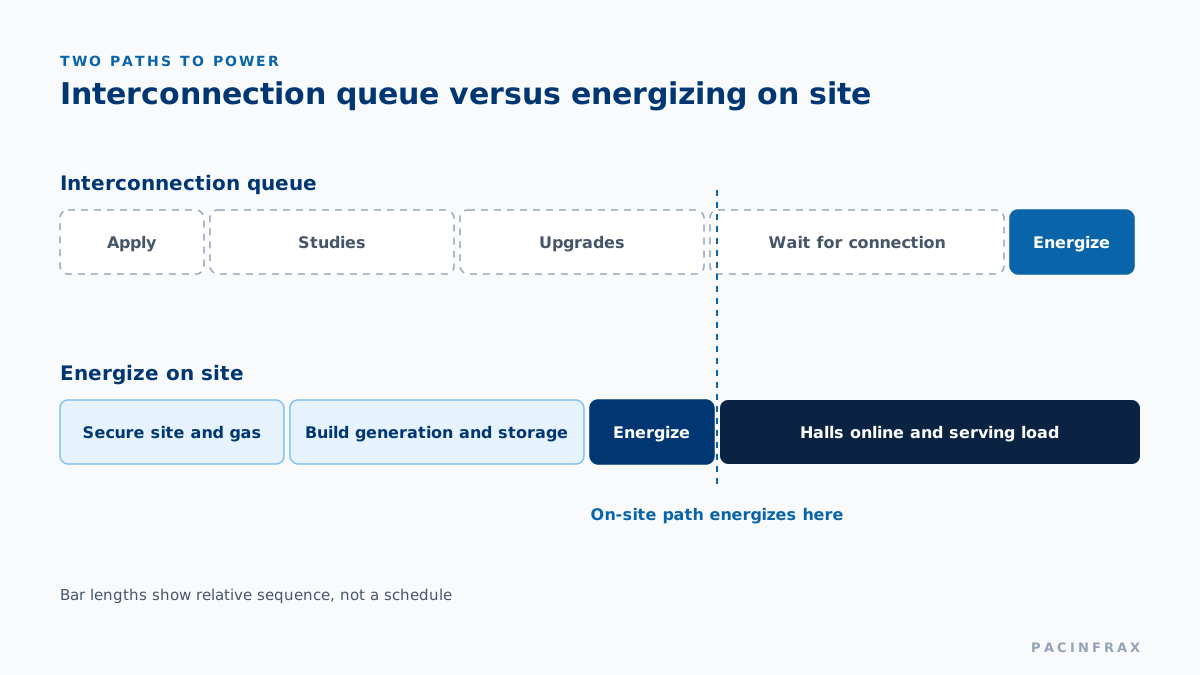
You plan your GPU delivery against a construction program you can inspect, instead of an interconnection queue position you cannot control. Your hardware lands in an energized hall.
Diagram: grid queue vs on site
Scale
Scale: 10–50 MW blocks that grow with your clusters
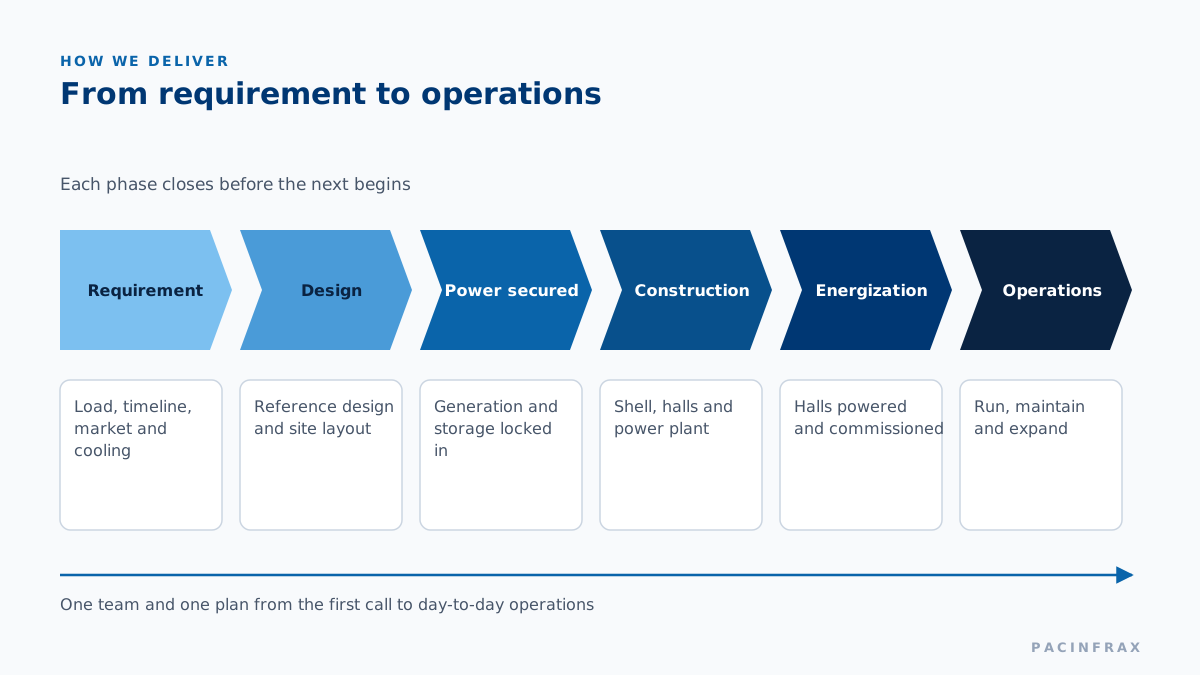
We organize every campus into hyperscale blocks of 10–50 MW. Each block has its own power, cooling and hall, so you contract the block you need now and reserve the next one on the same campus. In Vietnam alone we have 1,200 MW planned across four sites.
Scale: key points for your deployment
- Phase 1 at Nam Thang Binh, Da Nang, targets 20 MW of IT load in 2026–2027, on a 200 MW campus.
- Larger requirements combine several blocks on one campus, under one design basis.
- Smaller GPU deployments start in colocation halls and move up to a dedicated block.
What it means for your deployment
You avoid buying the whole campus on day one, and you avoid a second site search when your next cluster arrives. Expansion is a contract amendment on land and power already planned.
Diagram: delivery phases
Flexibility
Flexibility: buy capacity the way your team runs
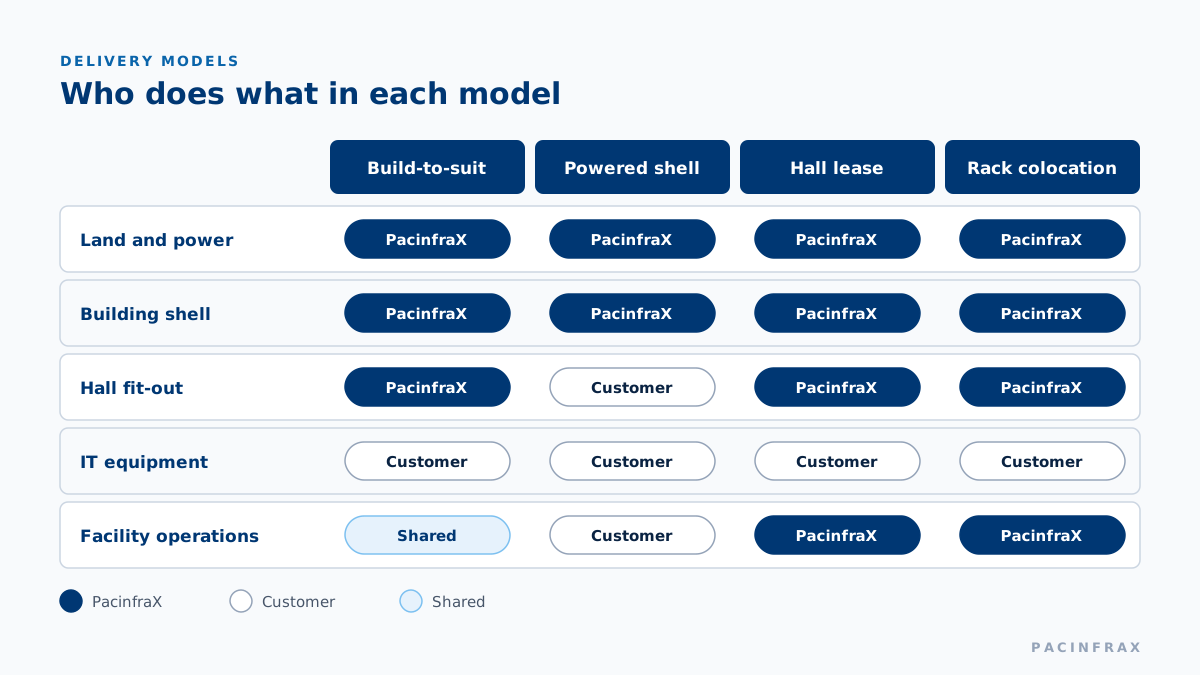
Some customers want a campus built around their own design. Others want racks live in a hall we operate. We offer four delivery models on the same power-first platform, and you can move between them as your needs change.
Flexibility: key points for your deployment
- Build-to-suit: a campus or hall designed to your specification and delivered as a finished facility.
- Powered shell: an energized building and power plant; your team fits out the hall.
- Hall lease and rack colocation: AI and GPU colocation in liquid-cooling-ready halls we operate.
- Power only: on-site generation, battery storage and bridge-to-grid design for your own facility.
What it means for your deployment
You choose how much of the stack you own. The power path, block size and design standards stay the same whichever model you pick.
Diagram: who does what
Partnership
Partnership: one accountable team, strong local partners
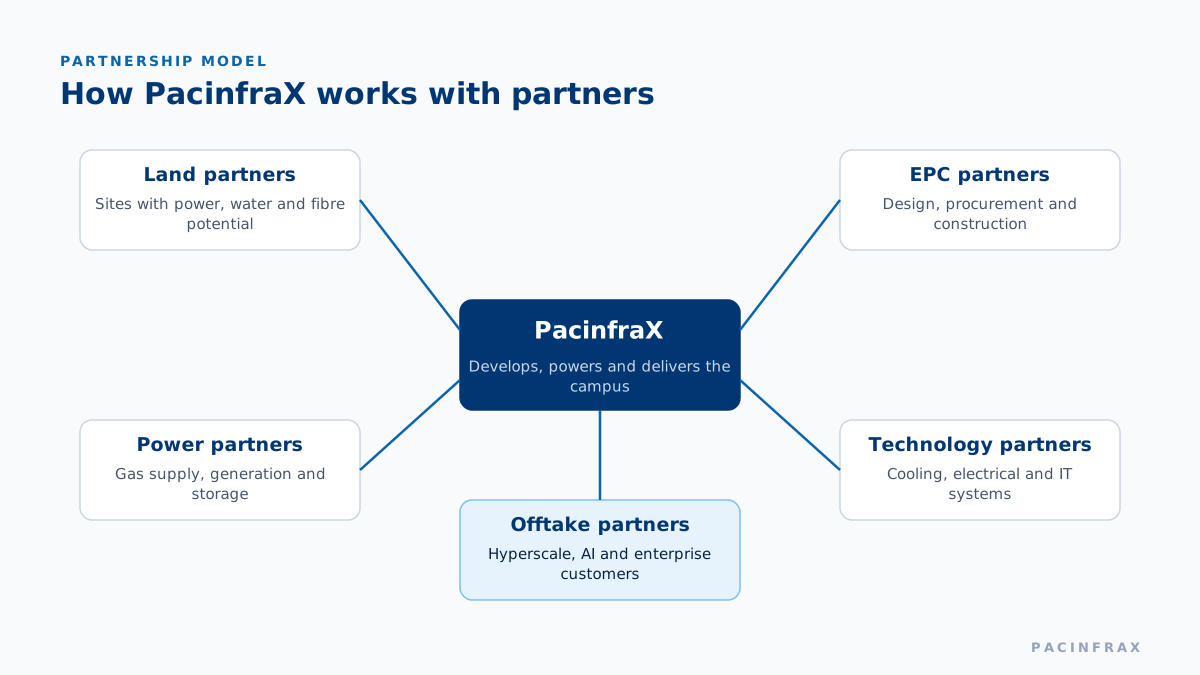
You deal with one developer-operator from the first call to operations. Behind that single point of contact sit the partners a campus needs: landowners, EPC firms, power and technology partners, host governments and, in Vietnam, companies of BIN Corporation.
Partnership: key points for your deployment
- Our leaders bring investment and EPC experience across more than 4 GW of solar, wind and data center capacity in Asia, and more than 25 years in capital markets.
- PacinfraX Vietnam signed four site agreements with companies of BIN Corporation, announced on .
- We work directly with host governments on permits, workforce and community plans.
What it means for your deployment
One contract, one schedule and one team to call. Local partners carry their scope, and we carry the result.
Diagram: PacinfraX and its partners
Compare
Grid-queue developer or power-first developer
Two ways to deliver the same AI campus. The difference shows up in the date your racks go live and in how you grow.
Grid-queue developer vs PacinfraX
| Question | Grid-queue developer | PacinfraX, power-first |
|---|---|---|
| First question answered | Where is the land? | Where does the power come from? |
| Energization date set by | The utility interconnection queue | The construction program for power and hall |
| Power and building | Built in sequence | Engineered and built in parallel |
| GPU load swings | Handled by the grid connection | Smoothed by on-site battery storage |
| Growth | New site search for the next phase | Next 10–50 MW block on the same campus |
| Who you call | Separate landlord, utility and builder | One developer-operator |
Running an RFP? Use our guide to writing an RFP for AI capacity and the site selection checklist.
Standards
Design standards built for AI
Each hall is designed around dense GPU workloads and handed over with as-built drawings, test records and operating procedures.
-
Liquid-cooling-ready halls
Space, piping routes and heat rejection for direct liquid cooling are part of the first drawing, sized to your racks. Design basis →
-
Redundancy set per hall
We set the redundancy of power and cooling hall by hall to match your workload, from training clusters to inference fleets. AI data centers →
-
Storage for AI load swings
Battery storage rides through events and smooths the fast load steps of large GPU clusters. Battery storage →
-
Segregated tenant zones
Each tenant gets its own secured zone, with separate access and clear boundaries inside the campus. GPU hosting →
Where
Power-first campuses in three markets
South ERCOT, Texas
An AI campus in development with on-site gas generation and storage. See Texas →
Minnesota
Minnesota, powered industrial site. See Minnesota →
Vietnam
1,200 MW planned across four sites, led by 200 MW at Nam Thang Binh, Da Nang. See Vietnam →
FAQ
Power-first delivery, answered
What does power-first mean at PacinfraX?
It means we design the power before the building. On-site generation, battery storage and the bridge-to-grid path are engineered with the hall, so capacity is energized when construction finishes.
Do I have to wait for a utility grid connection?
No. On-site generation and storage, or an already-powered site, energize the campus without waiting on the interconnection queue. Bridge-to-grid design connects the campus to the utility network when it arrives.
What capacity blocks can I contract?
Hyperscale blocks run from 10 to 50 MW and are phased, so you add capacity as you grow. Larger requirements combine blocks on one campus. Smaller GPU deployments fit our colocation halls.
Can I start in colocation and move to a dedicated block later?
You can start with racks in a colocation hall and move to a dedicated hall or block on the same campus as their clusters grow. The power path and design standards stay the same.
3 more questions
Who builds and operates the campus?
PacinfraX does. We act as one developer-operator for land, power, cooling and hall, working with EPC partners for construction. You deal with one team from site selection to operations.
Where can I get capacity from PacinfraX?
In three markets: South ERCOT, Texas; Minnesota, powered industrial site; and Vietnam, where we plan 1,200 MW across four sites. Phase 1 at Nam Thang Binh, Da Nang targets 20 MW of IT load in 2026–2027.
What should I bring to the first call?
Your target load in megawatts, the date you need it, your preferred market, the delivery model you have in mind and your cooling approach. We reply within two business days with a first view of site, power path and block size.
Ready for power-first capacity?
Tell us your load, timeline and preferred market. We reply within two business days with the location, power path and block size that fit.