Why AI racks need liquid
Every watt a server draws leaves as heat. Air is a poor carrier for that heat: it needs large volumes, big fans and wide spacing. Liquid carries far more heat per unit of volume, so a small loop does the work of a large air system. As GPU racks draw more power, air cooling reaches a practical limit and the rack needs liquid.
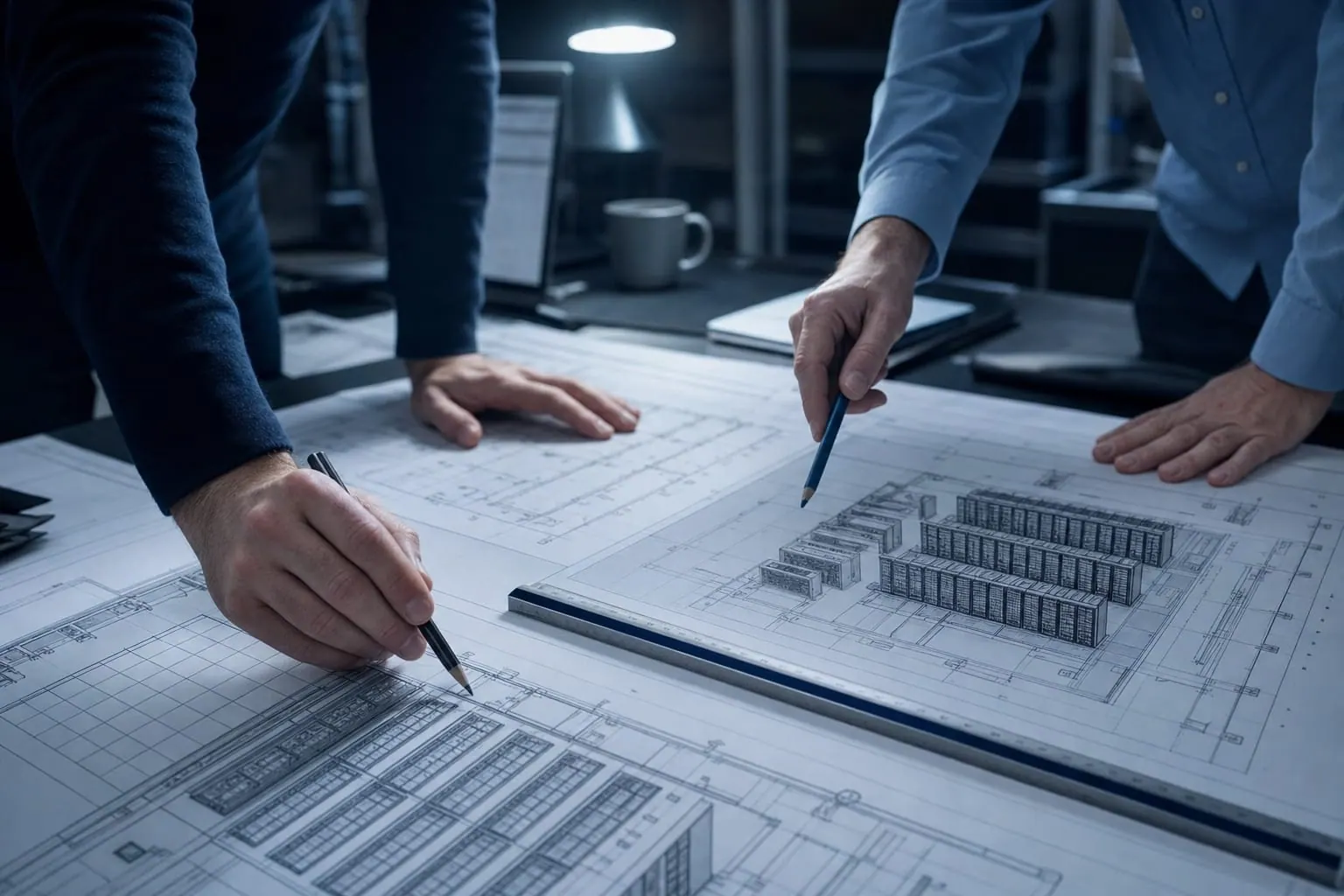
The change affects the whole hall. Cooling sets rack spacing, floor layout, pipe routes and part of the electrical design. That is why cooling belongs in the first design review.
The cooling options compared
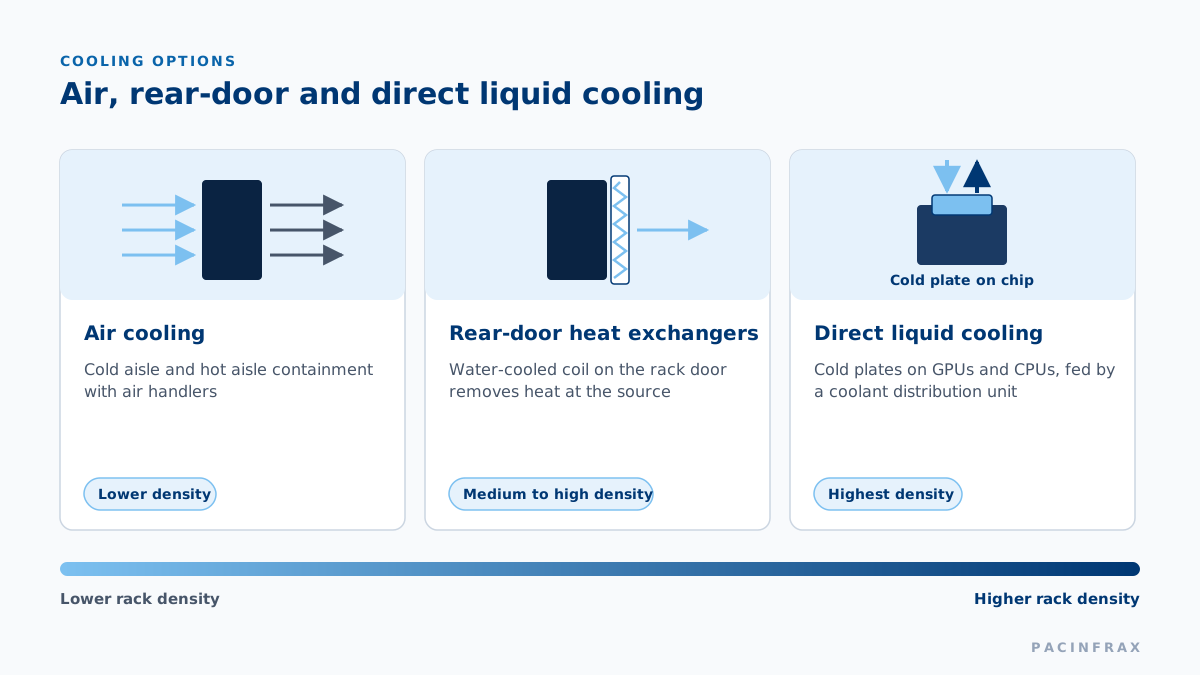
| Method | How it works | Best for | Hall requirements |
|---|---|---|---|
| Air cooling | Fans and air handlers move cold air through racks | Enterprise and lower-density racks | Containment and airflow management |
| Rear-door heat exchanger | Water-cooled panel on the rack back cools exhaust air | Mid-to-high density rows | Chilled water to each row |
| Direct-to-chip | Cold plates on processors move heat into a closed loop | GPU training and dense inference | Coolant distribution units, manifolds, secondary loop |
| Immersion | Servers sit in dielectric fluid in tanks | Specialized hardware designs | Tanks, fluid handling, different floor plan |
How a direct liquid-cooled loop works
A direct liquid-cooled hall has two loops that exchange heat but never mix. Understanding them helps you ask the right questions.
- Cold plates sit on the processors and absorb heat into coolant.
- Rack manifolds collect coolant from every server and connect to the row supply and return pipes.
- Coolant distribution units move coolant through the secondary loop and transfer its heat to the facility water loop.
- Heat rejection equipment outside the hall releases that heat to the environment, or reuses it.
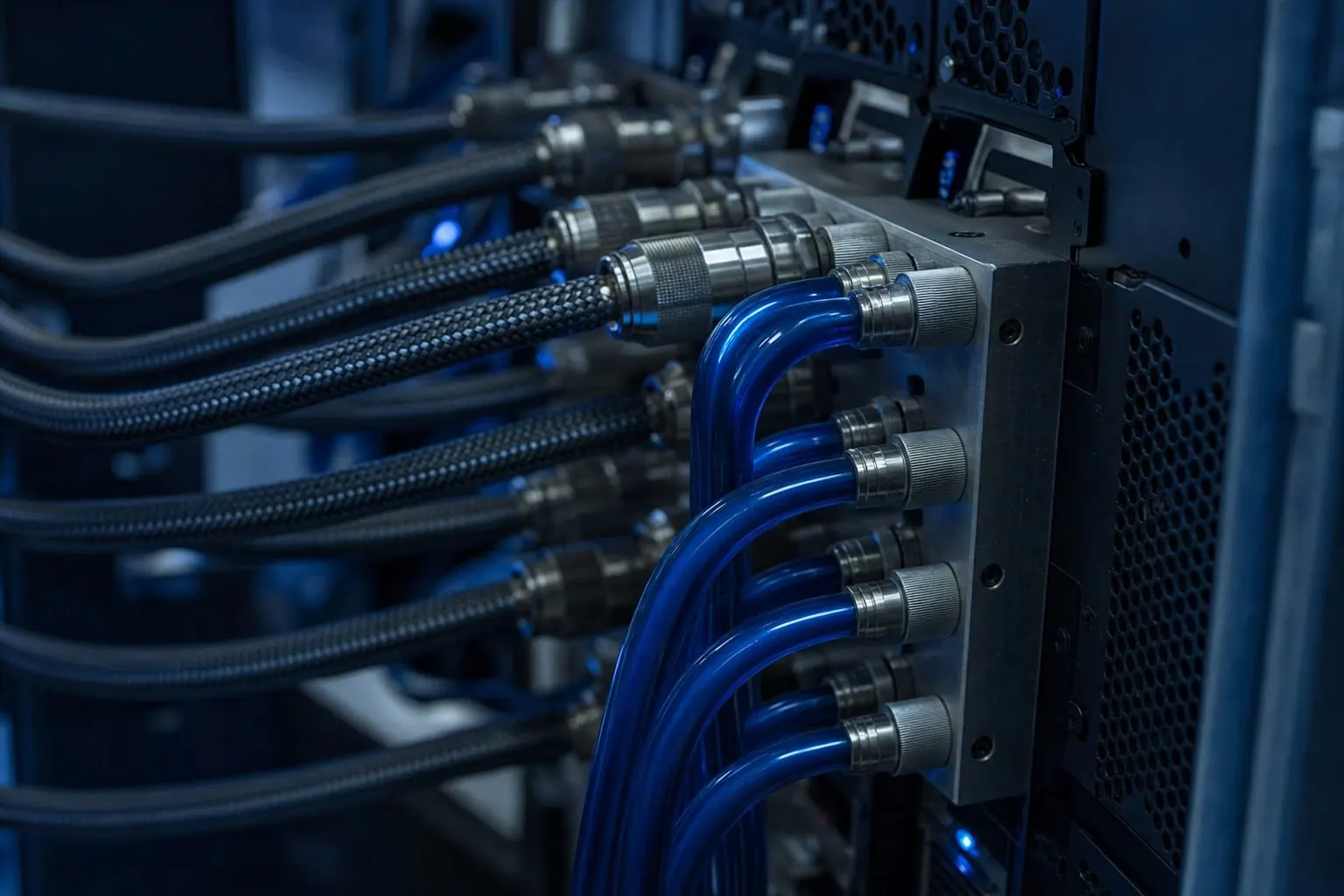
Heat reuse is a further option. Warm coolant leaving the racks can feed nearby buildings or industrial processes, which turns a cost into a useful by-product. Ask whether the campus layout leaves room for a heat offtake, because adding one later means new pipework.
A small share of heat still enters the room from memory, power supplies and networking, so a liquid-cooled hall keeps an air system for that remainder.
The equipment inside a liquid-cooled hall
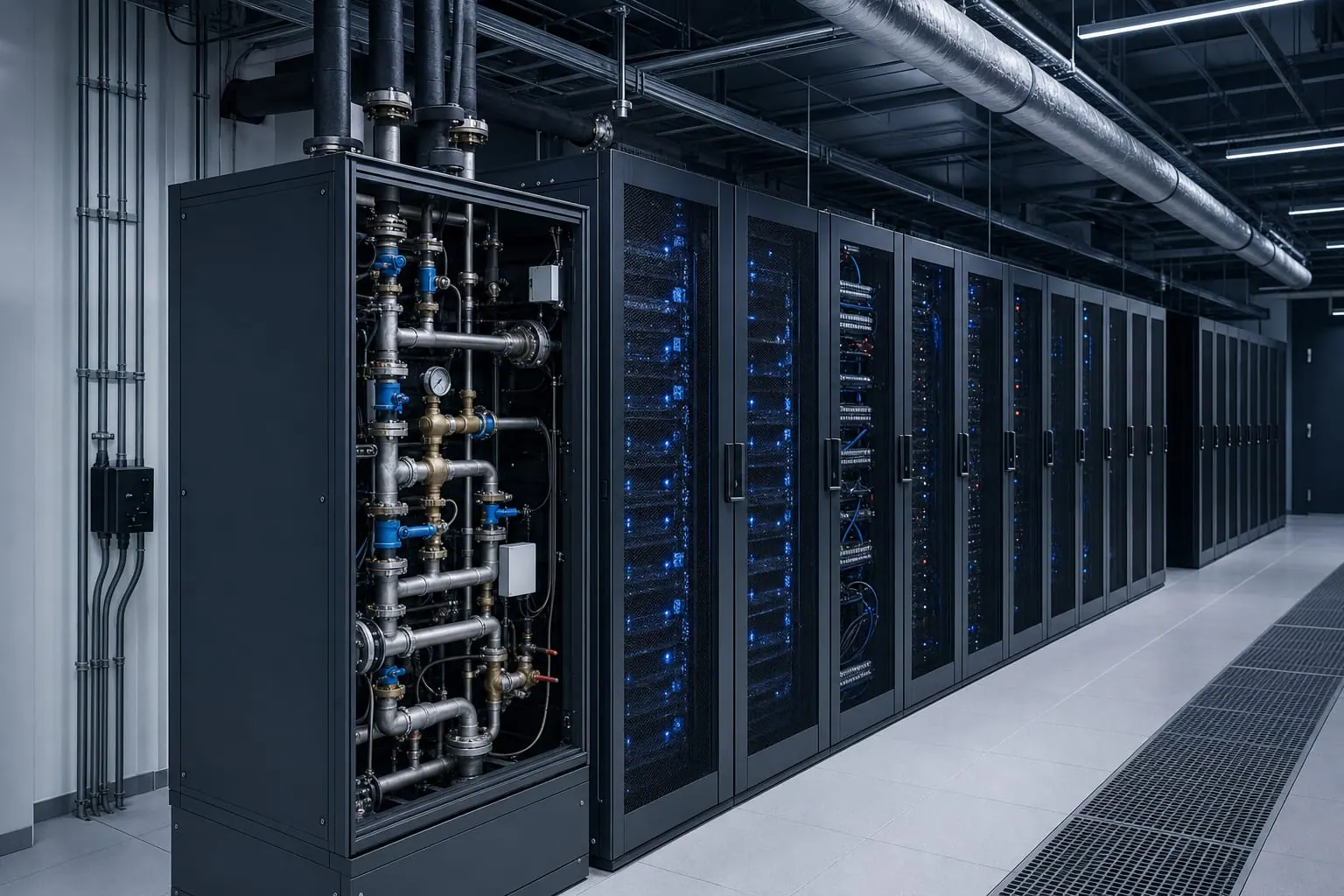
- Coolant distribution units: pumps, heat exchangers and controls; redundant pumps keep flow if one fails.
- Piping: supply and return mains with isolation valves for each row.
- Leak detection: sensors under manifolds and along pipe runs, tied to alarms and shutoff valves.
- Monitoring: temperature, flow and pressure at the rack, row and plant level.
- Heat rejection: dry coolers, chillers or other plant sized to the full heat load.
Match the method to your hardware
Your server vendor defines the cooling requirement for each model. Start there, then choose the hall.
| Your situation | Typical cooling | Next step |
|---|---|---|
| Standard enterprise servers | Air with containment | Confirm airflow and rack power limits |
| Mixed racks, some dense | Rear-door heat exchangers on dense rows | Confirm chilled water supply to the rows |
| Current-generation GPU systems | Direct-to-chip with residual air | Confirm the coolant specification and CDU capacity |
| Specialized immersion hardware | Immersion tanks | Confirm the provider supports the fluid and floor plan |
If you are weighing hosting options for dense clusters, read GPU hosting and the colocation specifications.
Design questions to put to a provider
- Which cooling methods is the hall designed and commissioned for?
- What coolant do you specify, and what is the supply temperature range?
- How are distribution units made redundant, and who services them?
- What leak detection and shutoff strategy protects the racks and the floor?
- How does the electrical design change for liquid-cooled rows?
- What is the heat rejection plan for local climate, and what water source does it use?
- Can I mix air-cooled and liquid-cooled racks in the same hall?
- Who trains my technicians on connecting and disconnecting server loops?
Put the answers in your RFP for AI capacity so every bidder responds to the same list.
Commissioning and operating a liquid-cooled hall
Liquid cooling adds procedures that air-cooled halls do not have. A provider should show you how each one is handled.
- Flushing and filling: pipework is cleaned, pressure tested and filled with coolant to specification before any server is connected.
- Load testing: heat load banks or live hardware prove flow, temperature and alarm response at full draw.
- Coolant quality: samples are taken on a schedule, because chemistry affects cold plates and seals.
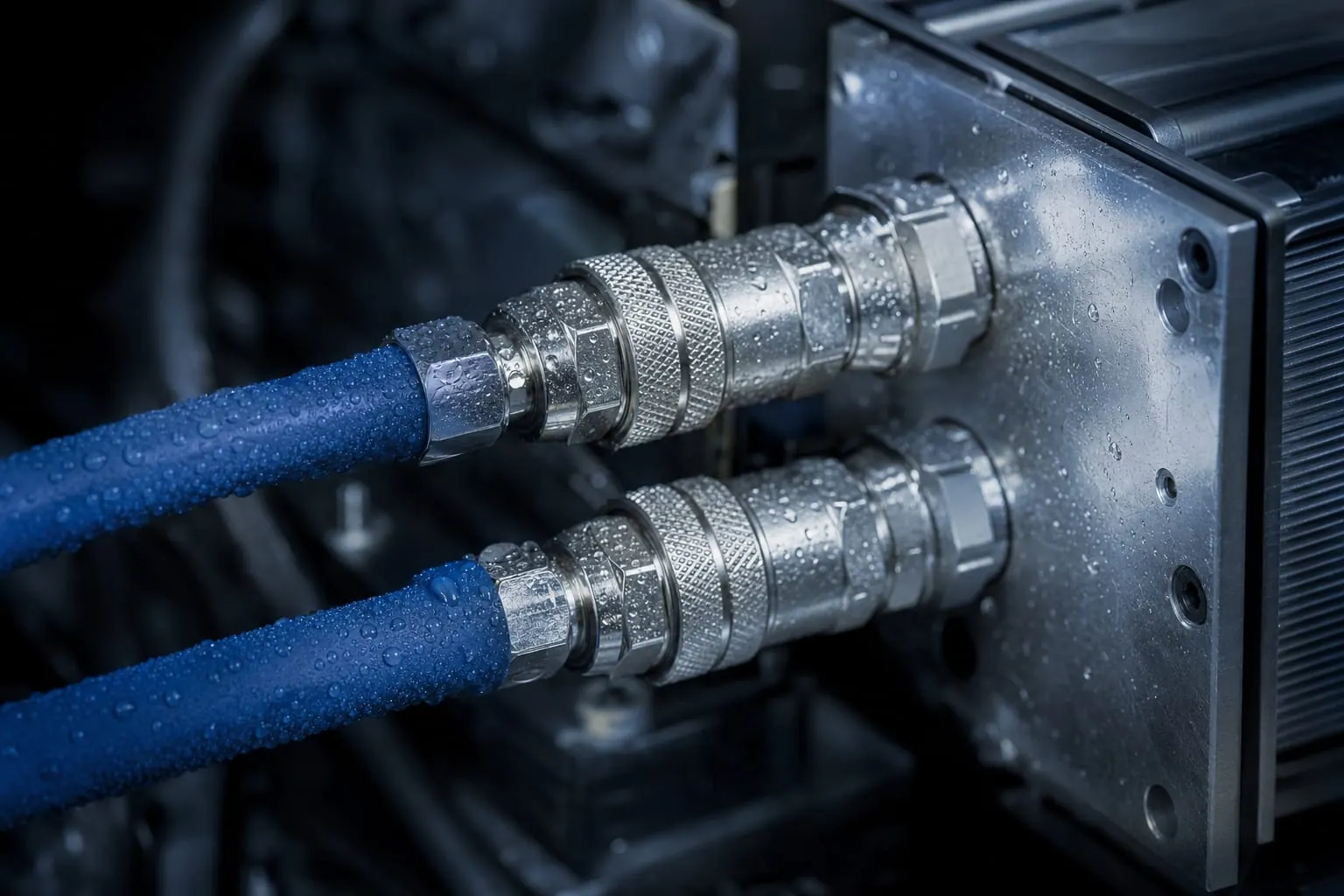
- Server changes: technicians follow a written procedure to connect and disconnect quick-disconnect fittings.
- Incident response: a leak alarm has a defined path, from isolation valve to inspection to return to service.
- Spares: pumps, hoses and fittings stay on site so repairs do not wait for shipping.
These routines are part of the service you buy. Ask for the operating procedures in writing, and ask who is on site when something goes wrong.
What liquid cooling changes in cost and schedule
Liquid cooling shifts spending rather than simply adding to it. You pay for piping, distribution units and heat rejection equipment, and you spend less on air handling and floor space. The comparison belongs in total cost per delivered kilowatt, as covered in our guide to delivery models.
- Design: cooling is fixed early, so layout and electrical drawings are completed in the right order.
- Procurement: distribution units, manifolds and heat rejection equipment have their own lead times; order them with the long-lead electrical items.
- Commissioning: flushing, pressure tests and load tests add steps before the first server is connected.
- Operations: staff need training on coolant handling, alarms and server connection procedures.
- Growth: a hall with spare pipe capacity and space for additional distribution units adds liquid-cooled rows without a rebuild.
Schedule risk falls when the provider writes the commissioning plan into the contract and shares test results at handover.
How cooling connects to power
Liquid cooling usually lowers the share of power spent on moving heat, because pumps use less energy than large fans. That leaves more of the campus supply available for compute. The change also moves electrical loads: distribution units and pumps need dependable power, and a cooling failure stops the cluster as surely as a power failure.
The cooling plant should be on the same resilient supply as the racks. Read what 50 MW of AI capacity looks like to see how heat load and electrical load scale together, and power-first development for the supply behind them.
How PacinfraX does it
PacinfraX offers AI and GPU colocation in liquid-cooling-ready halls, and AI data center blocks of 10 to 50 MW.
Send us your hardware model and rack density, and we will confirm the cooling route in the design review. Start with Request capacity.
Frequently asked questions
When do I need liquid cooling instead of air?
When rack density passes what air can remove economically. Your server vendor states the limit for each model. Training clusters on current GPU systems generally need direct liquid cooling, while lower-density inference and enterprise racks can stay on air or rear-door heat exchangers.
What is the difference between rear-door and direct-to-chip cooling?
A rear-door heat exchanger is a water-cooled panel on the back of the rack that cools exhaust air. Direct-to-chip cooling places cold plates on processors and moves heat through a liquid loop, so most of the heat never enters the room air.
Is immersion cooling better than direct-to-chip?
Immersion submerges servers in dielectric fluid and suits specific hardware designs. Direct-to-chip fits standard rack servers. Choose the method your hardware warranty and operations team can support.
Is liquid cooling safe near electrical equipment?
Yes, when designed correctly. Loops are closed, use quick-disconnect fittings that seal when parted, and include leak detection and shutoff valves. Piping stays separate from electrical distribution, and operators train on the response procedure.
Can I retrofit liquid cooling into an air-cooled hall?
Sometimes, but it takes planning. You need pipe routes, floor space for distribution units, a heat rejection path and sufficient electrical capacity. A hall designed for liquid cooling from day one avoids that rework.