Use this glossary alongside the RFP guide, the comparison of colocation, build-to-suit and powered shell and the walk-through of what 50 MW of AI capacity looks like.
Delivery models
The four ways to get capacity, and the document that fixes the design.
5 terms: Delivery models
- Powered shell
- A building shell delivered with energized utility or on-site power, structure, roof and site works, but without the internal fit-out. The customer or its contractor installs power distribution, cooling and racks inside. It suits buyers with their own design teams who want power certainty and control of the interior.
- Build-to-suit
- A facility designed and built to one customer's specification on a long-term lease. The developer secures land and power, builds the hall to the customer's density, cooling and redundancy requirements, and operates or hands over the site. It suits large, long-horizon AI deployments.
- Hall lease
- A lease of a complete data hall, usually in megawatt blocks, with power and cooling infrastructure already installed. The customer fills the hall with its own racks and controls its own operations inside the hall, while the operator runs the building and shared plant.
- Colocation
- Renting rack space, a cage or a suite inside a shared data center, with power, cooling, security and connectivity provided by the operator. It lets a company house its own servers without building a facility, and scales from a few racks to many.
- Basis of design
- The document that records the design targets for a facility: load, density, redundancy, cooling approach, standards and operating conditions. Every drawing and specification traces back to it. Agreeing the basis of design early prevents rework once construction starts. Buyers should ask to see it before signing.
Capacity and load
The numbers that size a project.
5 terms: Capacity and load
- IT load
- The electrical power drawn by the IT equipment itself: servers, storage and network gear. It excludes the power used for cooling, lighting and losses. Capacity contracts for AI usually quote IT load in megawatts because it is the number that tells you how many racks fit.
- Critical load
- The portion of electrical load that must stay powered through a utility outage, normally the IT equipment and the cooling needed to keep it running. Backup power, UPS and generation are sized to the critical load, so the figure sets the cost and complexity of the power plant.
- kW per rack
- The electrical power drawn by one rack, and the standard measure of density. Traditional enterprise racks draw a few kilowatts, while GPU racks draw many times more. The figure decides the cooling method, the floor layout and how many racks a megawatt of IT load supports.
- Capacity block
- A defined increment of data center capacity, such as a single data hall, that is built, commissioned and leased as one unit. Blocks let a campus grow in steps, and give customers a clear path to add capacity on the same site.
- Phased delivery
- Building and energizing a campus in stages instead of all at once. Each phase has its own power, cooling and hall capacity, brought online as customers commit. Phasing aligns capital with demand and puts the first racks into service sooner.
Power distribution
How electricity reaches the rack.
5 terms: Power distribution
- UPS
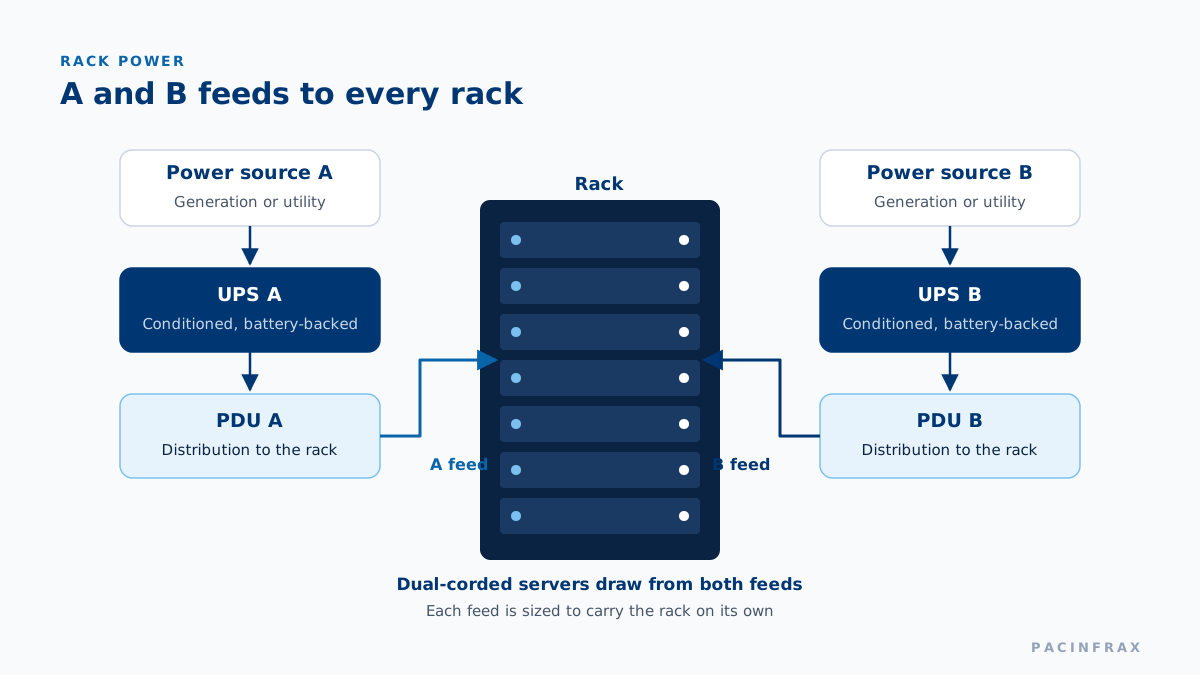
- An uninterruptible power supply holds the load on batteries for a short time while backup generation starts or the utility comes back. It also conditions power, smoothing dips and spikes. UPS sizing and topology are central to a hall's reliability and are specified in the basis of design.
- A+B feed
- Two independent power paths from separate sources to every rack, so a failure on one path leaves the rack running on the other. Dual-corded servers draw from both feeds. A+B distribution is the standard way to deliver resilient power to critical equipment.
- Switchgear
- The assembly of breakers, switches and protection that controls, isolates and protects electrical circuits. In a data center, switchgear connects utility, generators and storage to the distribution system, and lets operators isolate equipment for maintenance without interrupting the load. Ask how many independent paths the gear provides.
- PDU
- A power distribution unit takes power from the upstream distribution and delivers it to racks, often with metering and circuit protection. Rack PDUs sit inside the cabinet and feed individual servers, while floor-level PDUs serve rows. Metered PDUs show how much each rack draws.
- Reciprocating engine
- An internal combustion engine, here running on natural gas, that drives a generator. Banks of engines can serve a campus as on-site generation. They start quickly, run efficiently at part load and can be added in modules as the campus grows.
On-site power and the grid
Energy supply terms that decide when capacity goes live.
5 terms: On-site power and the grid
- BESS
- A battery energy storage system stores electricity in battery containers with power conversion and controls. At an AI campus it provides ride-through for sharp load swings, supports peaks and smooths on-site generation. BESS also helps a campus move between on-site and grid power without interruption.
- Bridge-to-grid
- A design that energizes a campus on on-site generation and storage first, then connects to the utility grid later. The campus starts earning without waiting for the utility, and the grid connection becomes a second source rather than a precondition.
- Interconnection queue
- The ordered list of projects waiting for a utility or grid operator to study and approve their connection to the network. Studies, upgrades and construction can take years, so the queue often sets the energization date for projects that depend on the grid alone.
- Energization
- The moment a facility receives live power from its source, whether the utility, on-site generation or both. Energization precedes full commissioning and load release. In a lease, the energization date is the milestone that matters most, because racks cannot run without it.
- Power island
- The part of a campus that holds the power plant: generation, storage, switchgear and controls. A power island can operate separately from the grid, and serves one or more data halls through a medium-voltage distribution ring. Its size sets how much capacity the campus can energize before any grid connection arrives.
Cooling
The systems that remove heat from dense racks.
5 terms: Cooling
- PUE
- Power usage effectiveness is total facility energy divided by the energy used by IT equipment. A value closer to 1.0 means less energy spent on cooling and overhead. Compare PUE figures only when they cover the same period and boundary, because definitions vary between sites.
- CDU
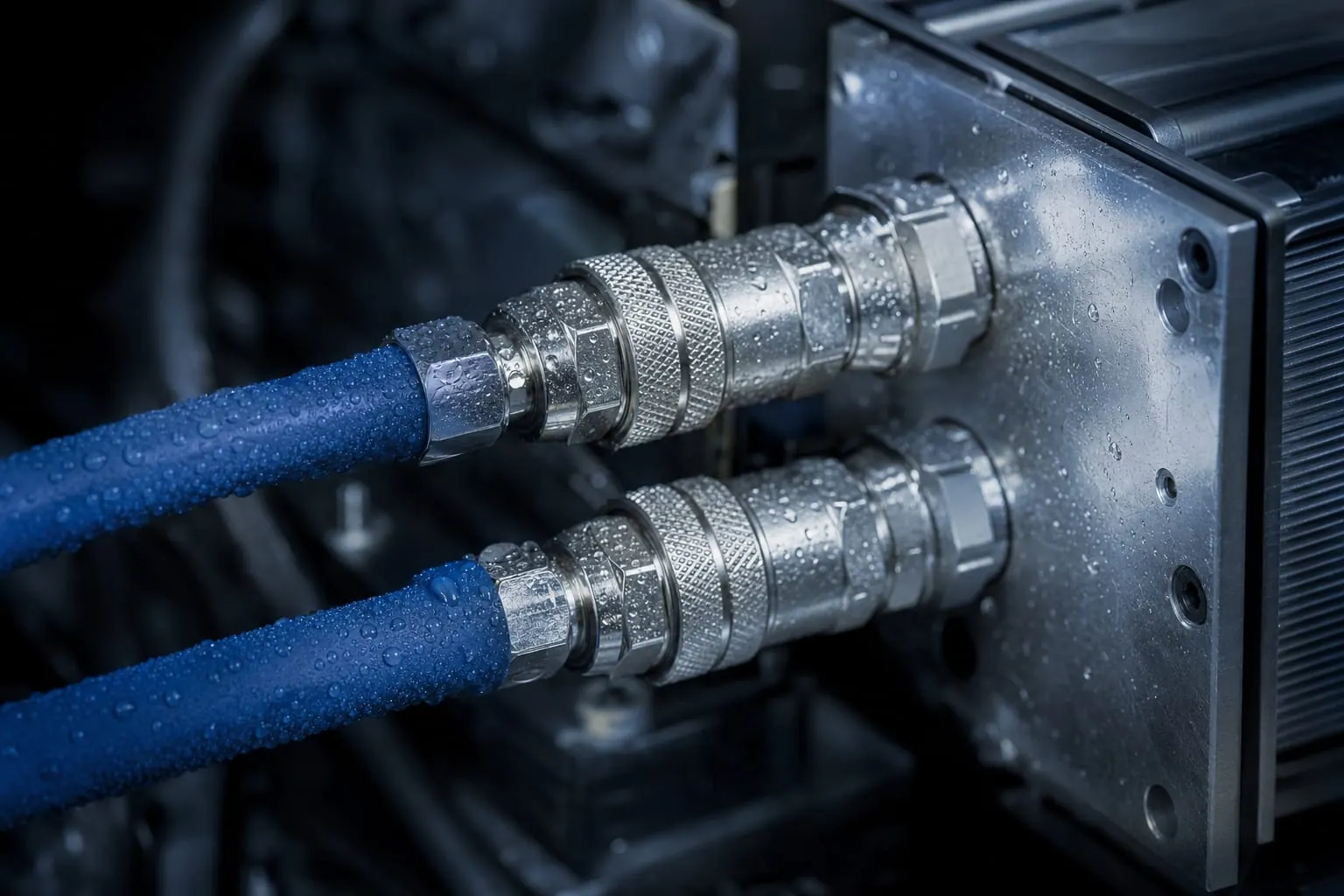
- A coolant distribution unit moves cooling liquid between the facility's heat rejection loop and the loops that serve the racks. It controls temperature, pressure and flow, and isolates the two loops with a heat exchanger. CDUs are the core of a direct liquid cooling design.
- Direct-to-chip cooling
- A liquid cooling method in which cold plates sit on processors and accelerators and carry heat away in a coolant loop. It removes most of the heat at the source, which allows much higher rack densities than air alone, and is the standard approach for GPU clusters.
- Rear-door heat exchanger
- A radiator-style door mounted on the back of a rack. Hot exhaust air passes through coils carrying chilled water, which removes much of the heat before it reaches the room. It raises the density an air-cooled hall can support without changing the servers.
- Liquid-cooling-ready
- A hall designed with the space, structure, piping routes and heat rejection capacity to add liquid cooling, even when the first racks use air. It protects the customer from a costly rebuild when density rises, and is the PacinfraX design standard.
Compute and customers
The workloads and buyers that drive requirements.
5 terms: Compute and customers
- GPU cluster
- A group of servers fitted with graphics processing units and linked by a high-speed network so they work as one machine. Clusters used to train AI models need dense racks, strong cooling and a low-latency network inside the hall. Ask for the cluster size you plan to deploy.
- Training and inference
- Training builds a model by processing large datasets across many accelerators for days or weeks, and needs very large, tightly networked clusters. Inference runs a trained model to answer requests, and needs more distributed capacity close to users, with lower latency.
- Hyperscaler
- A very large cloud or internet company that operates data centers at huge scale and contracts capacity in large blocks. Hyperscalers set the pace for the industry, and typically ask for energized capacity on a fixed date with room to expand.
- Neocloud
- A cloud provider built around GPU compute for AI workloads. Neoclouds rent accelerator capacity to AI developers, and need dense, liquid-cooled colocation or hall capacity that can be energized quickly and grown in steps. Many neoclouds start in colocation and move into larger halls as demand grows, so expansion rights matter.
- AI lab
- An organization that researches and trains AI models. Labs need large training clusters, long-term capacity commitments and reliable power, and often contract directly with developers for build-to-suit halls. Labs usually plan several phases, so the right to expand on the same campus is a key contract term, along with a firm energization date.
Network and connectivity
How the hall connects to carriers, clouds and customers.
5 terms: Network and connectivity
- Cross-connect
- A direct physical cable between two customers, or between a customer and a carrier, inside the same facility. Cross-connects avoid the public internet, giving lower latency and predictable performance, and are priced per connection by the operator. Ask how many cross-connects the hall can support and how quickly they are installed.
- Meet-me room
- A secured room where carriers and customers terminate fibre and connect to each other. In a carrier-neutral facility it is the hub where tenants pick providers and add routes without leaving the building. Ask whether the room is shared or operated by an independent party, how many carriers are present and how cabling is secured.
- Carrier-neutral
- A facility that allows many network carriers and cloud on-ramps to connect, rather than tying tenants to one provider. Carrier neutrality gives customers choice, price competition and the ability to change provider without moving servers. Ask which carriers are on site today and how new ones are added to the campus.
- Diverse routes
- Fibre paths that enter a site through different conduits and follow physically separate routes. Diverse routes protect connectivity against a single cut. Buyers should ask how many diverse routes serve the campus and where they enter the building. Ask for a route map and confirm the paths do not share a bridge or duct.
- Latency
- The time a signal takes to travel between two points, usually measured in milliseconds. Latency matters most for inference, trading and interactive services. Training clusters tolerate distance, and are placed where power is available. Ask which regions you must reach within a given latency.

Operations and service
What happens after the keys are handed over.
5 terms: Operations and service
- Remote hands
- On-site technicians who carry out physical tasks for a customer who is not present: rebooting a server, swapping a drive, checking cables or installing equipment. Remote hands is usually a billed service, with defined response times in the service agreement.
- SLA
- A service level agreement sets measurable commitments, such as power availability, cooling temperature ranges and response times, with remedies if they are missed. Read the definitions closely, since the measurement window and exclusions decide what a percentage really means. Compare agreements on the same basis before choosing between proposals.
- Commissioning
- The structured testing of a facility's systems before the customer takes it over: power, cooling, controls and failover. Commissioning proves the design works under load and records the results. Complete test records are part of a documented handover. Ask what tests are run, who witnesses them and when results are shared.
- N+1 and 2N
- Redundancy designs. N+1 means one spare unit beyond what the load needs, so a single failure causes no outage. 2N means two complete, independent systems each able to carry the full load. 2N costs more but tolerates the failure of an entire path.
- Availability
- The share of time a service or facility is working as promised, usually expressed as a percentage over a year. Higher availability needs more redundancy and tighter operations. Ask how it is measured and whether planned maintenance counts. Ask whether the figure covers power, cooling or the whole service.
Construction and approvals
The project terms that appear in schedules and permits.
5 terms: Construction and approvals
- EPC
- Engineering, procurement and construction: a contractor that designs, buys equipment for and builds a facility under one contract. EPC firms carry construction risk and schedule responsibility, and are central partners in building campuses to a single design. Ask which EPC partner builds each block and what experience it has with high-density halls.
- Entitlement
- The set of land-use approvals needed before construction: zoning, site plan, building permits and related consents. Entitlement status is a key part of site selection, since an unentitled parcel adds months and uncertainty. Ask a developer which approvals are complete, which are in progress and who is responsible for each one.
- ALTA survey
- A detailed land survey prepared to standards set by the American Land Title Association and the National Society of Professional Surveyors. It shows boundaries, easements, access and improvements, and is a standard part of a land transaction package. Ask whether one exists for the site and when it was last updated.
- Air permit
- An approval from an environmental regulator that sets emission limits and monitoring for equipment that burns fuel, such as engines or turbines. A campus with on-site generation needs one, so permit status is a gating item on the schedule. Ask what the permit status is and how it limits engine count.
- SCADA
- Supervisory control and data acquisition is the control system that monitors and operates power and cooling equipment from one place. A campus control room uses SCADA to coordinate generation, storage, switchgear and the halls, and to log events for audit.
Glossary questions, answered
What is the difference between a powered shell and build-to-suit?
A powered shell delivers the building and the power, and the customer fits out the inside. Build-to-suit delivers a finished hall designed to the customer's specification. Powered shell gives more control. Build-to-suit gives more speed and less customer effort.
What is the difference between MW of IT load and MW of utility capacity?
IT load counts only the power drawn by IT equipment. Utility capacity includes cooling and losses as well, so it is larger. Always check which figure a developer quotes before comparing proposals.
How do I find out what a term means for my project?
Bring the term to the first call. Our team explains it in the context of your load, timeline and market, and reflects it in the basis of design.
Which terms matter most for a GPU cluster?
Start with kW per rack, direct-to-chip cooling, CDU, A+B feed and BESS. Together they describe how much heat and power each rack brings, how the heat leaves and how the power stays steady when the load swings.
What is the difference between N+1 and 2N?
N+1 adds one spare unit to what the load needs, so one failure causes no outage. 2N builds two complete, independent systems, each able to carry the full load. 2N costs more and tolerates the loss of a whole path.
Is the glossary specific to PacinfraX?
No. The definitions are general industry terms. Where PacinfraX uses a term in a specific way, such as liquid-cooling-ready, the entry says so.
Sources and further reading
Definitions follow common industry usage. These public sources give more detail on standards, grid processes and efficiency.
- TIA-942 data center standard, infrastructure and redundancy reference.
- US Department of Energy: data centers and servers, guidance on energy use and efficiency.
- ERCOT: large load integration, an example of a grid operator's interconnection process.
See how these terms apply to our campuses in AI data centers and colocation.