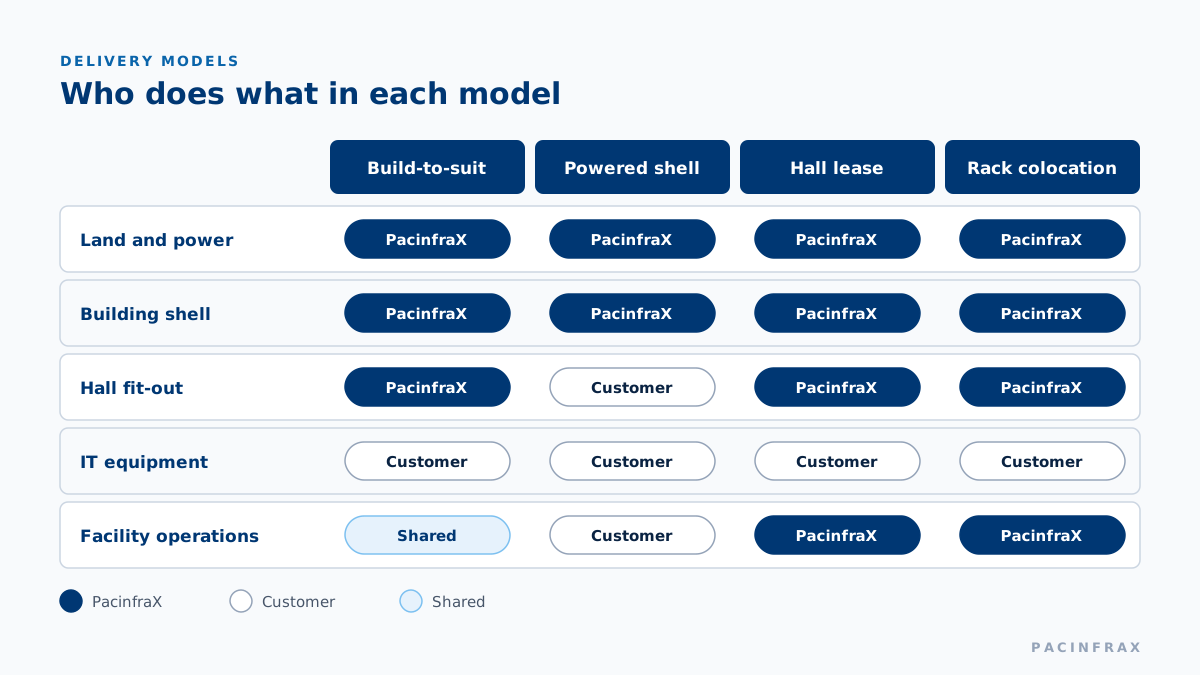
The four delivery models side by side
AI buyers usually meet four models: rack colocation, hall lease, build-to-suit and powered shell. They sit on one spectrum. At one end the provider carries almost everything and you carry a monthly bill. At the other end you carry design and construction and gain control of every decision inside the building.
| Model | What you receive | Who builds the hall | Typical fit |
|---|---|---|---|
| Rack colocation | Racks with power and cooling in a shared hall | Provider | Tens of racks up to a few rows |
| Hall lease | A private hall or suite inside a provider campus | Provider | Single-tenant clusters at hall scale |
| Build-to-suit | A facility designed to your specification | Provider, with EPC partners | Dedicated blocks, 10–50 MW |
| Powered shell | Energized site and building envelope | You, or your contractor | Buyers with an in-house design team |
Colocation: live racks with the least to build
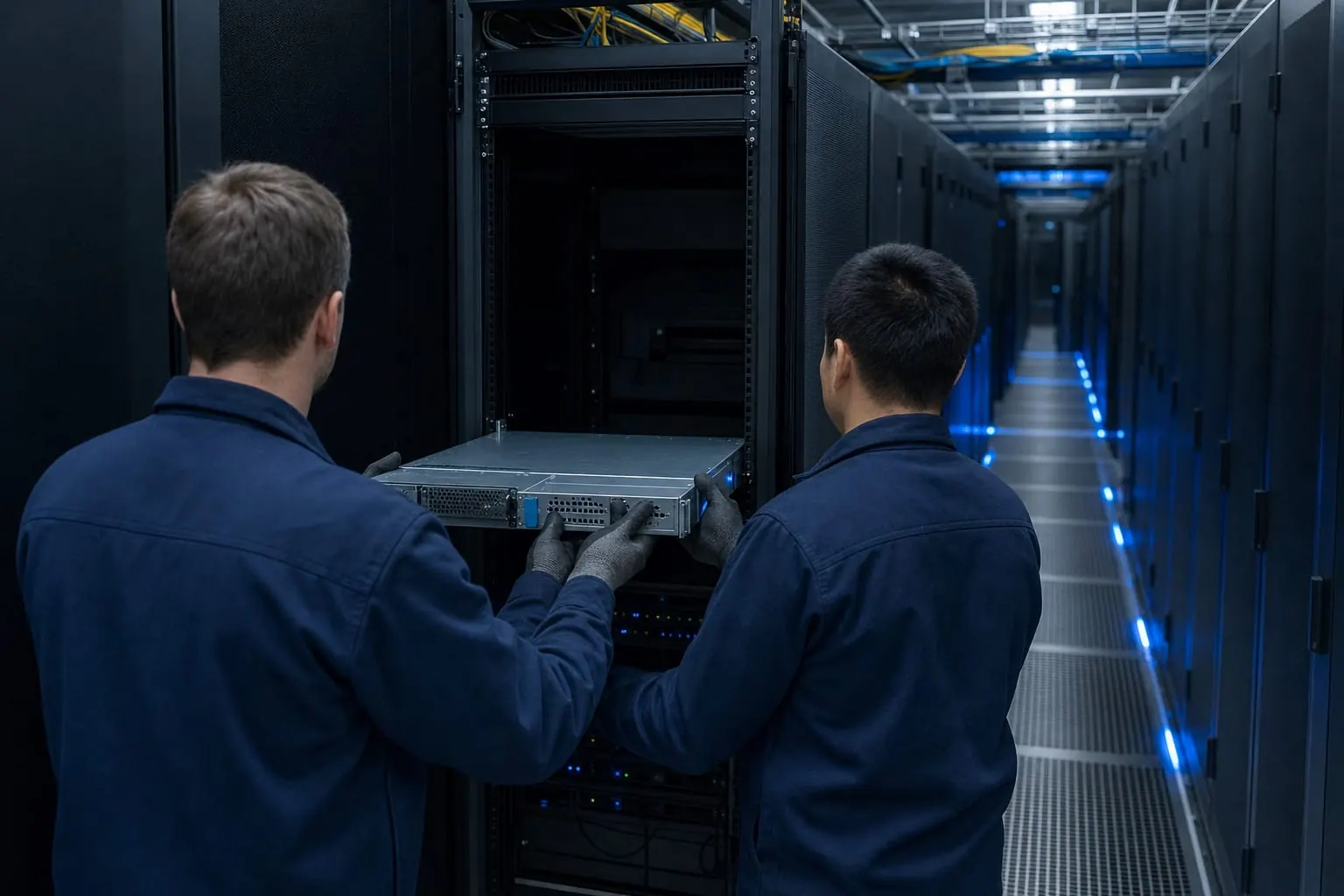
In colocation the provider builds and runs the building, the electrical plant and the cooling. You supply servers, networking and software. You pay for power capacity, space and services, and the provider handles everything behind the rack.
- Best for: teams with a defined cluster size, a short deadline and no wish to run a facility.
- You control: hardware, network design, software and operations inside your racks.
- You give up: choices about the building, the cooling plant and the redundancy design.
- Watch for: rack density limits, cooling type, expansion rights and cross-connect rules.
If you are weighing a move, read how to move your servers into colocation for the step-by-step path.
Build-to-suit: a facility designed around your racks
Build-to-suit starts with your requirement: megawatts, rack density, cooling, redundancy and security zones. The provider secures the site and power, designs the hall and plant to that specification, builds with EPC partners, and operations are shared between provider and customer under a long-term agreement.
- Best for: dedicated blocks in the 10–50 MW range, where a shared hall cannot hold the cluster.
- You control: the design basis, the cooling approach and the growth plan across phases.
- You give up: speed of a ready-made hall; a new build takes longer than moving into one that exists.
- Watch for: who owns design changes, how phases are priced and what happens at the end of the term.
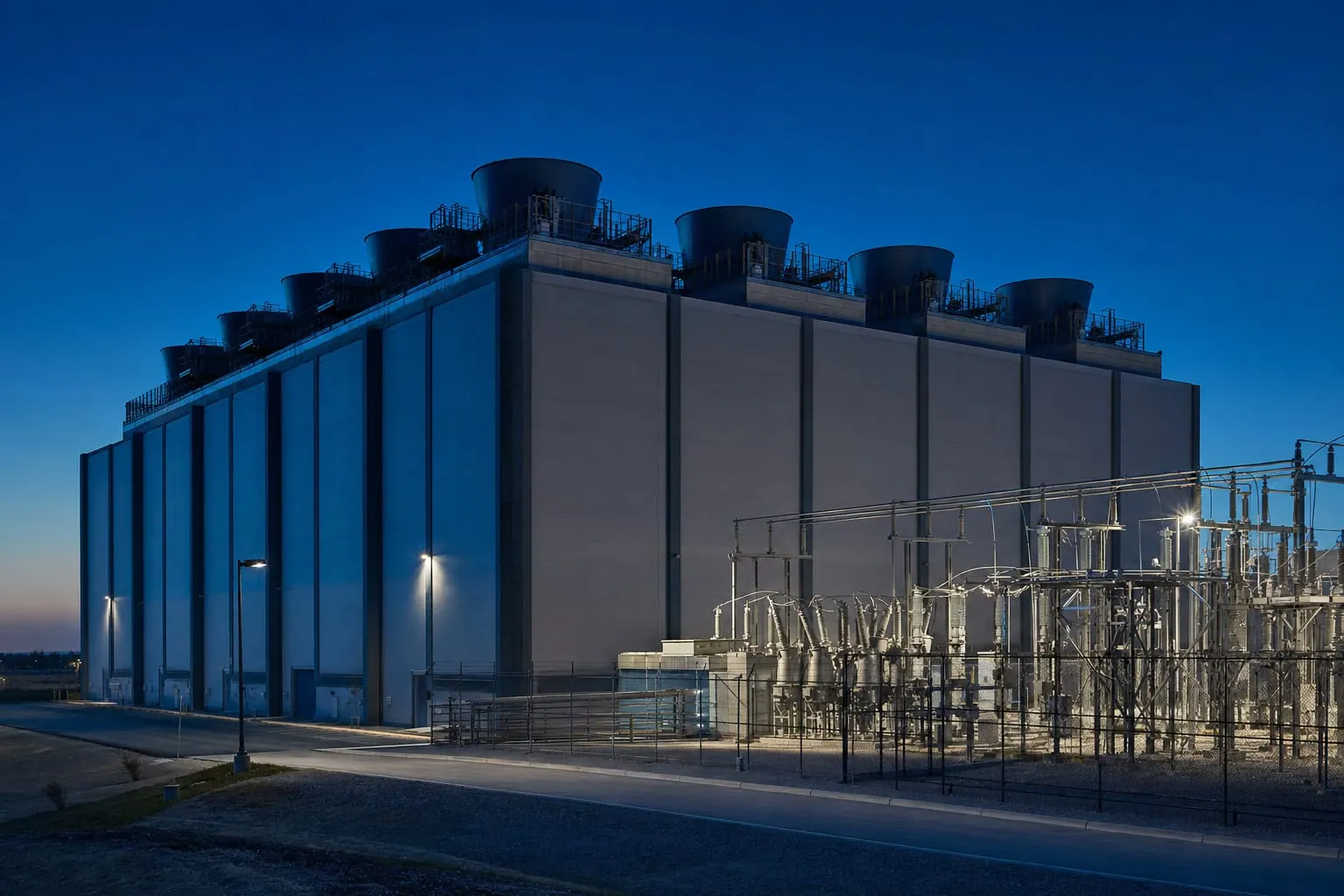
PacinfraX describes this model on its build-to-suit page.
Powered shell: energized land, your design
A powered shell delivers a site with power secured and an outer building, and leaves the interior to you. You design the white space, the distribution and the cooling, then appoint your own contractors or work with the provider to deliver the fit-out.
- Best for: buyers with a standard design they repeat across sites and an in-house engineering team.
- You control: almost everything inside the envelope.
- You carry: design, procurement, commissioning and the schedule risk of the fit-out.
- Watch for: the exact handover point for power, who owns the substation and how future capacity is reserved.
See the provider side on the powered shell page.
How to choose: a decision table
Start from your situation, not from a model. Match the row that describes you.
| If your situation is… | Start with | Why |
|---|---|---|
| A defined cluster and a deadline measured in months | Colocation | A finished hall removes construction from your critical path. |
| A cluster that outgrows a shared hall within a year or two | Colocation now, build-to-suit planned | You go live fast and secure a dedicated block in parallel. |
| A dedicated requirement of 10 MW or more, with your own specification | Build-to-suit | Power and hall are designed together to your density and cooling. |
| A repeatable in-house design and a construction team | Powered shell | You keep control of the interior and avoid paying a provider for it. |
| Unclear requirement, uncertain demand | Colocation | You can scale rack by rack without a long commitment to a building. |
Compare cost the way operators do
Rent per rack or per kilowatt hides the largest items. Build a comparison on total cost per delivered kilowatt over the full term. Use the same list for every provider.
- Power: is energy bundled in the rate or passed through at cost, and with what metering?
- Cooling: does the rate cover liquid cooling, or do you pay for the loop and the coolant distribution separately?
- Fit-out: who pays for cabinets, containment, busway and meet-me connections?
- Services: remote hands, shipping and receiving, storage and cross-connects.
- Growth: reserved capacity, expansion pricing and the notice you must give.
- Delay: what a late energization date costs your program, and who carries it.
Power sets the real delivery date
All three models depend on energized capacity. A hall that is built but unpowered delivers nothing. Ask each provider where the power comes from, who holds the connection agreement and what the fallback is if the utility date moves. ERCOT shares load forecasts and historical power load for its control area on its Load page, which is a useful starting point when you assess a Texas site.
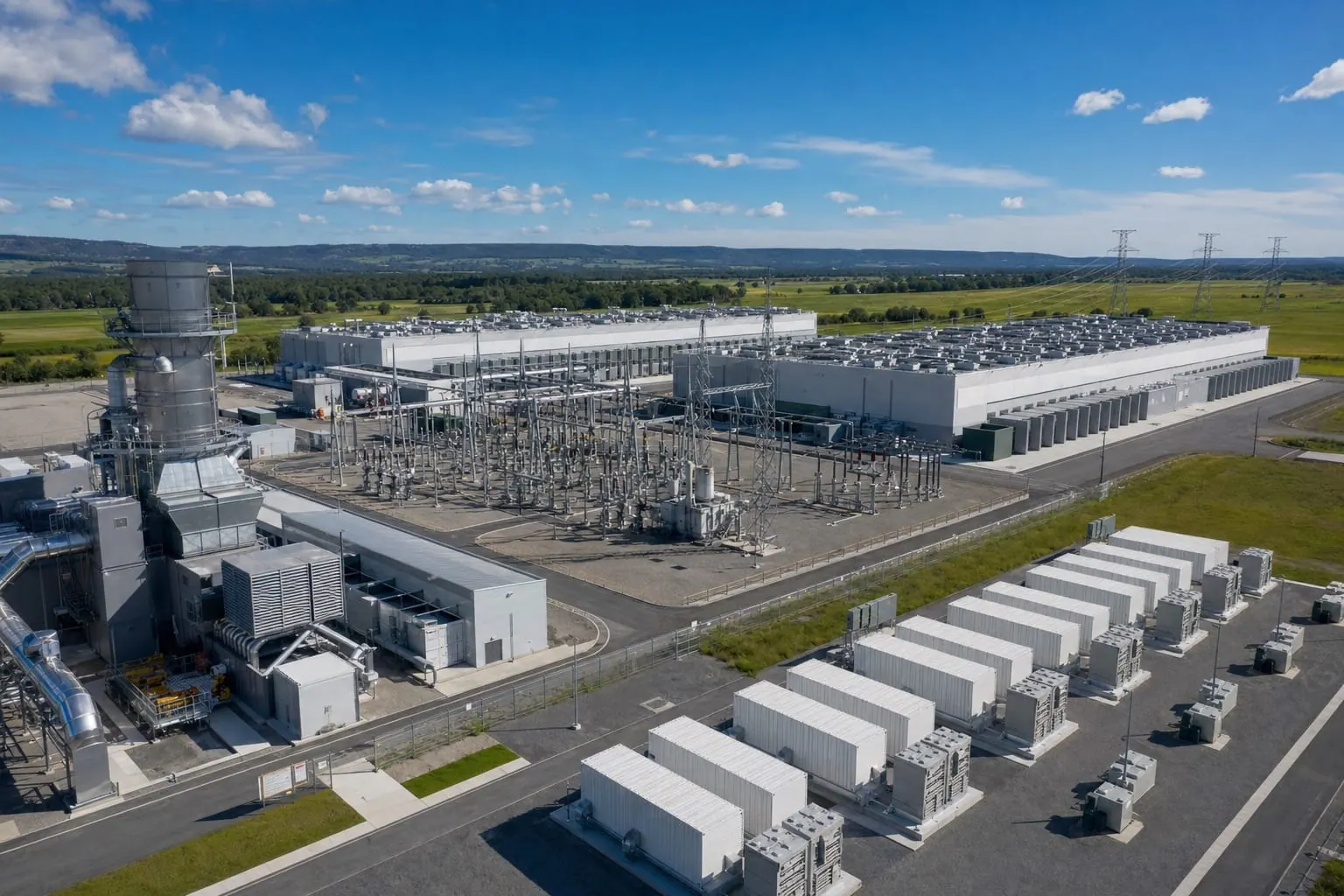
On-site generation with battery storage, followed by a bridge to the grid, removes the queue from your critical path. The same idea applies to any of the three models. Our guide to power-first development explains the approach.
Ten questions to ask every provider
- How many megawatts can you energize for me, and by which quarter?
- Where does the power come from today, and what is the path to grid connection?
- What rack density can the hall hold, and is direct liquid cooling available now?
- How do you handle redundancy, and can I set it for my workload?
- What are the expansion rights, and how many blocks can sit on this campus?
- How do I access the site, and who can enter my zone?
- Which network carriers and cloud on-ramps are available?
- What is on the invoice besides rent?
- What documents do I receive at handover?
- Who is the single accountable contact for my project?
For capacity requests, our guide to writing an RFP for AI capacity covers the eleven parts of an RFP, ten questions to ask and how to score responses.
How PacinfraX does it
PacinfraX develops and operates power-first AI data center campuses. We offer all three routes on the same footing: AI and GPU colocation in liquid-cooling-ready halls, build-to-suit and powered shell in hyperscale blocks of 10–50 MW, and power infrastructure that energizes a campus with on-site natural gas generation, battery storage and a bridge to the grid.
We work in South ERCOT, Texas, in Minnesota and in Vietnam. Read about the power-first model, or send us your requirement and we will tell you which route fits.
Frequently asked questions
Which model is fastest for an AI cluster?
Colocation is fastest when a finished hall with the right power and cooling already exists. If you need more capacity than a colocation hall can offer, build-to-suit on a site with an energized power path is the next fastest route, because the provider designs power and hall together.
What is the difference between build-to-suit and powered shell?
In build-to-suit the provider designs, builds and usually operates the facility to your specification. In a powered shell you receive an energized site and building envelope, then you or your contractor design and fit out the interior, including cooling, distribution and white space.
Can I start in colocation and move to build-to-suit later?
Yes, and many teams do. Colocation proves the workload and the operating model while a larger block is designed. Ask your provider for expansion rights and a path from hall-scale colocation to a dedicated block on the same campus.
Who is responsible for cooling in each model?
In colocation the provider owns the cooling plant and you own the rack-level hardware. In build-to-suit the provider owns the design and plant to your specification. In a powered shell you own the cooling design and the plant inside the building.
How do I compare prices across the three models?
Compare total cost per delivered kilowatt over the full term, not rent alone. Include power pass-through, cooling, fit-out, remote hands, cross-connects, expansion fees and the cost of delay if energization slips.